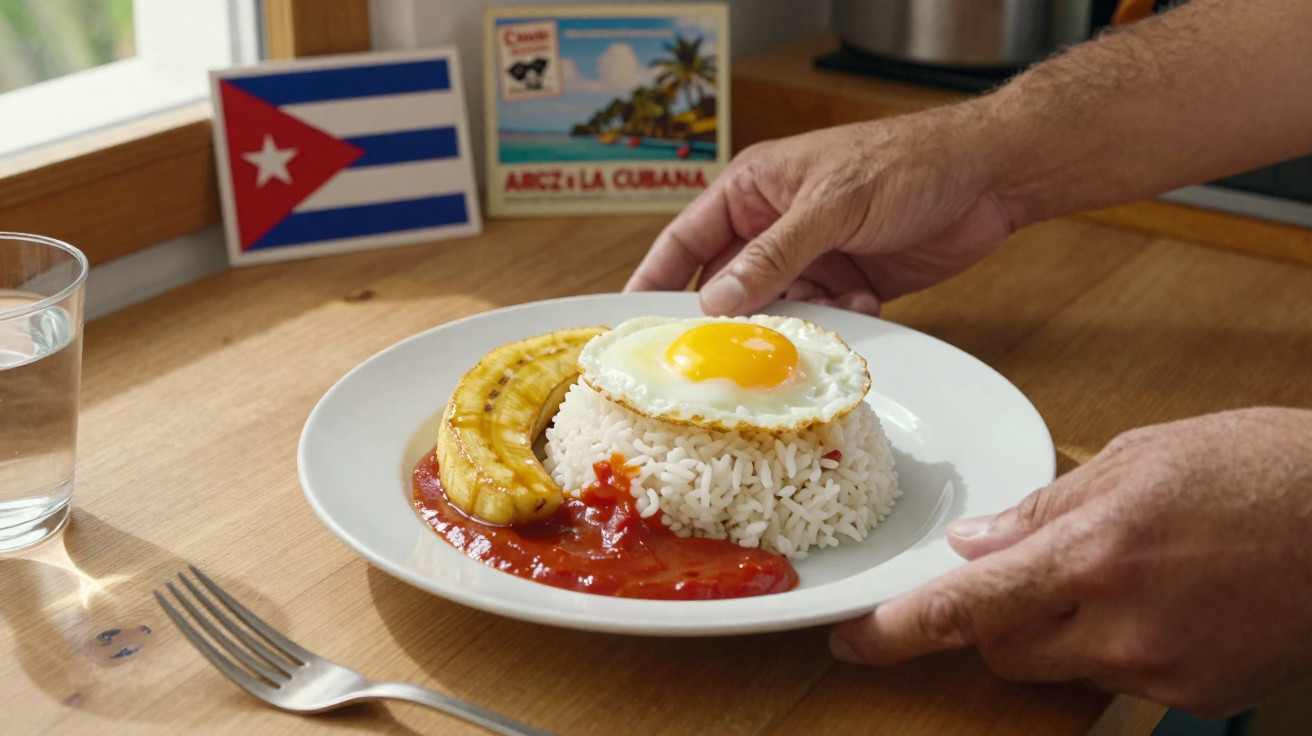
Across countless European dinner tables, an unassuming serving of rice, egg and tomato sauce conceals a remarkably complicated history.
For many people in France and Spain, “riz à la cubaine” evokes childhood immediately: white rice, a fried egg, tomato sauce pooled alongside it, and sometimes a piece of fried banana. Although its name seems to point directly to Havana, Cuban families would scarcely recognise the dish. How, then, did this everyday canteen staple acquire an exotic-sounding name that is not quite accurate?
The familiar plate that Cuba hardly eats
When French or Spanish readers imagine “Cuban rice”, they tend to picture much the same thing. It is inexpensive, uncomplicated and quick to prepare – exactly the sort of meal an exhausted parent might make on a weekday evening.
- Steamed white rice, frequently shaped into a tidy mound
- A single fried egg with a soft yolk
- A sizeable serving of tomato sauce or ketchup
- In many recipes, a fried banana or sliced plantain
The combination is comfortingly familiar throughout Southern Europe and in parts of Latin America. Cubans, however, are more likely to mention entirely different rice-based dishes.
In Cuba, rice is generally served with hearty stews or beans, including arroz con picadillo (rice with minced meat), moros y cristianos (rice and black beans), and congrí. The orderly combination of rice, egg and tomato, finished with banana, does not occupy the same role in everyday Cuban cooking.
Despite its name, the dish known in Europe as “Cuban rice” is far more Spanish than Cuban in its modern form.
From colonial routes to school canteens
The most widely accepted explanation for this discrepancy begins in the colonial era. As the Spanish empire extended across the Caribbean, staple ingredients travelled with it. Rice, cultivated extensively in Asia and later in the Americas, became an important food across Spain’s overseas territories.
Spanish settlers in Cuba and nearby islands adapted to the ingredients available to them. These included rice, tropical bananas, tomatoes, and eggs supplied by smallholdings and backyard chickens. Putting them together produced affordable, substantial meals using local produce while still appealing to Iberian preferences.
A name created at a distance, not in Havana kitchens
Food historians believe that “a la cubana” was probably coined in Spain, not Cuba. During the late 19th and early 20th centuries, names referring to colonies gave dishes an air of unfamiliarity and adventure – at least for people dining who had never travelled beyond the peninsula.
Against that background, describing a basic rice dish as “Cuban” lent imagination to an otherwise humble plate. Comparable naming habits appeared elsewhere: French bistros previously served “riz à l’indienne” with little resemblance to Indian cuisine, while British menus embraced “Hawaiian” pizza with tinned pineapple originating from neither Hawaii nor Naples.
The adjective “Cuban” worked less as a geographic label and more as a marketing trick, suggesting sunshine, sweetness and distance.
The Canary Islands’ special role
Spain’s Canary Islands were particularly important in the dish’s spread. Large numbers of Canarian migrants travelled to Cuba and other Caribbean territories, creating strong connections across the Atlantic.
Rice was cheap, while bananas, including plantains, grew locally. Tomatoes and eggs were readily available too. Together, they made an ideal everyday meal for households needing to make tight budgets go further.
When migrants returned to the Canaries, “Cuban-style” rice gained popularity. It gradually travelled from migrant homes to modest restaurants and bars, before reaching mainland Spain and France through cookbooks, migration and, eventually, school lunch menus.
Why canteens embraced “Cuban rice”
With the growth of mass education and workplace cafeterias during the 20th century, the dish offered everything catering managers needed:
- Low cost: rice and eggs are affordable and store well
- Flexibility: tomato sauce may be homemade, tinned, or replaced with ketchup
- Straightforward portions: mounds of rice and individual eggs make servings consistent
- Wide appeal: familiar tastes that most children eat without complaint
By the 1970s and 80s, “riz à la cubaine”, or its Spanish equivalent arroz a la cubana, seemed firmly embedded in the weekly canteen rotation, as instantly recognisable as pasta bolognese or fish fingers.
What makes the combination so satisfying
Its enduring appeal partly comes from the way its flavours and textures meet on the fork. Every mouthful provides a subtle contrast:
| Component | Role on the plate |
|---|---|
| Rice | A neutral foundation that absorbs sauce and yolk |
| Fried egg | Richness and creamy yolk, with slight crispness around the edges |
| Tomato sauce | Acidity and sweetness to offset the starch |
| Banana or plantain | Sweet, caramelised flavours and an added sense of comfort |
The dish also has emotional significance for many households. It can bring back memories of speedy dinners before homework, grandparents who “could only cook two things”, or seaside holiday lets where the cupboards contained only a handful of essentials.
More than a national recipe, “Cuban rice” acts as a shared childhood memory across different countries.
How Cubans actually eat rice
To understand the divide between the name and the reality, it is necessary to consider Cuban meals today. Rice remains fundamental, but it is normally paired with beans or meat rather than simply with an egg and tomato.
Some familiar Cuban combinations are:
- Moros y cristianos: white rice and black beans cooked together
- Congrí: a related preparation, often using red beans and pork fat
- Arroz con picadillo: rice served alongside minced beef stew containing olives and spices
- Arroz amarillo: yellow rice with chicken or other meats, coloured with annatto or saffron substitutes
Bananas and plantains are certainly part of Cuban meals – fried, boiled or mashed – but they tend to be served as accompaniments rather than within a defined “Cuban rice” recipe. As a result, the European dish is better understood as a distant cousin than a faithful version.
A case study in misleading food names
Riz à la cubaine belongs to a long list of place-named foods created with little input from the places named. Food historians regard such labels as records of older fantasies and power relationships, rather than impartial geographical descriptions.
In the colonial period, references to faraway territories could make inexpensive ingredients appear novel. Diners were able to remain at home while imagining travel through flavour. The countries assigned these names often see only a faint reflection of themselves in the resulting dishes, if they see themselves at all.
From a 2026 viewpoint, this prompts questions about how food associated with former colonies is discussed. Some chefs now seek to address such mismatches by changing menu names or identifying particular regions and communities rather than using broad national labels.
Making your own “Cuban rice” at home
Preparing the dish now does not mean recreating an untouched Cuban tradition; it means taking part in a long European reinterpretation of Caribbean ingredients. That history need not reduce its comfort, though understanding it can influence how it is described and served.
Home cooks commonly adjust the basic format according to what they have available. Some replace white rice with brown or jasmine rice, while others choose grilled vegetables over fried banana. A small number add chorizo or sausages, moving the plate still further towards Spanish cooking.
One useful point is that seasoning makes a substantial difference. Plain rice, a pinch of smoked paprika stirred into the tomato sauce, and a little garlic cooked in the oil before the egg is cracked in can easily turn school-dinner nostalgia into a weeknight favourite.
Words and ideas worth unpacking
Two expressions regularly appear in discussions of this dish: “Creole” and “criollo”. They refer to cooking shaped by European, African and Indigenous traditions in territories once governed by European powers. Both terms are applied loosely – and at times inaccurately – on restaurant menus to imply spice or a general Caribbean mood.
French food writing occasionally calls riz à la cubaine vaguely “Creole”, despite its actual history being Iberian with Caribbean elements. This does not make the food any less enjoyable, but it illustrates how readily marketing language can drift away from fact.
Why this small plate matters in bigger conversations
For anyone interested in food origins, “Cuban rice” poses a wider question: what occurs when a name survives longer than the history that produced it? Retaining the label while supplying context lets people hold on to their memories with a clearer understanding of its roots.
Consider a simple example: a parent serves the meal and explains to their child that, strictly speaking, it is more Spanish than Cuban. Nothing changes on the plate, but the discussion changes. Ordinary dinners can then offer a quiet way to speak about migration, trade, and the ways cultures borrow from one another – and sometimes rename those borrowings in the process.

















Comments
No comments yet. Be the first to comment!
Leave a Comment