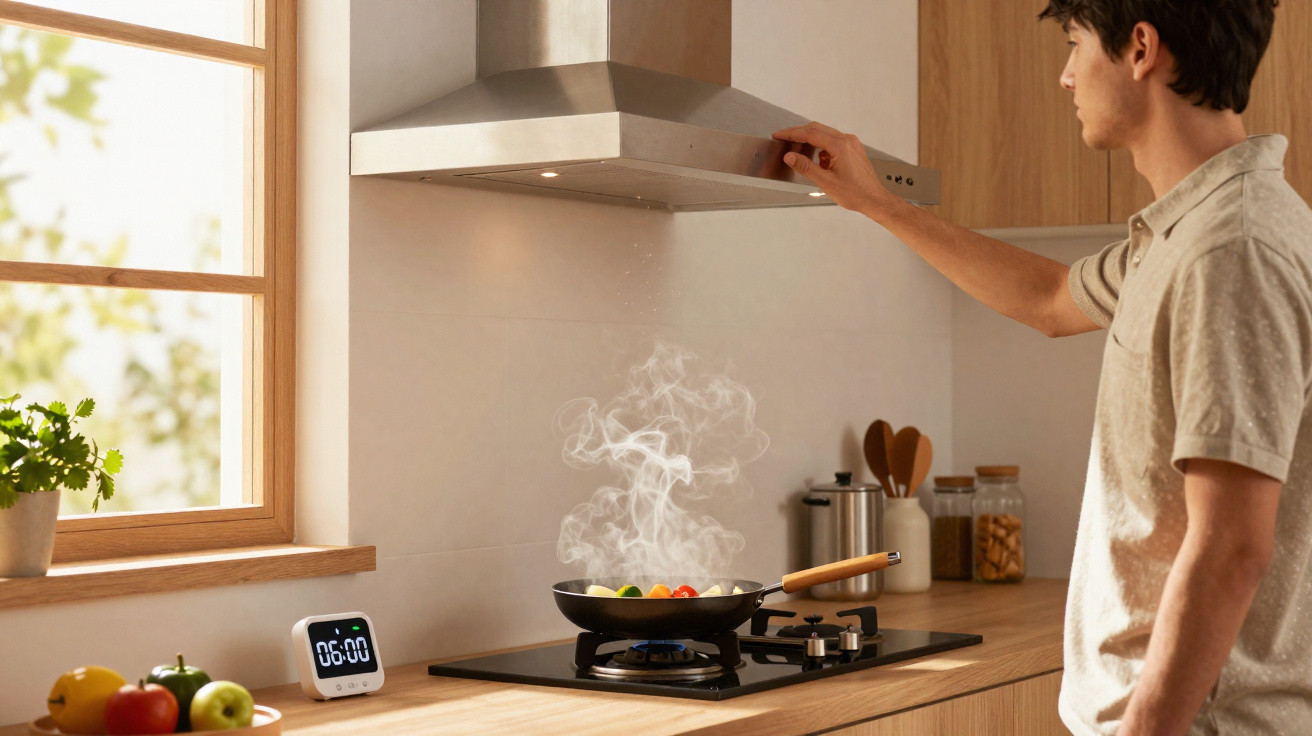
The frying pan crackles, onions sizzle, and a pale haze begins to drift along the kitchen ceiling.
From the living room someone calls that it “smells like a chip shop in here”, and you jab the extractor fan button with an oily finger. It whirs into action-slowly, half-heartedly-like the hood has had enough of pasta steam and burnt toast.
On the worktop sits a small grey box, about the size of a paperback, pulsing green. It’s a household air tester, borrowed for “a quick experiment” that was meant to take ten minutes and has somehow swallowed the whole evening. As the oil warms, as the garlic hits the pan, as the bacon renders, the readings flicker and climb.
Six minutes later, the room feels… changed. And the tiny screen is telling a story most kitchens never get to hear.
What a 2025 kitchen air test just revealed about your extractor fan
The first shock wasn’t the smell at all-it was the figures. The particle reading jumped as soon as the oil reached frying heat, then surged again with each movement of the pan. Above the hob, the air turned into an unseen broth: fine grease mist, specks of browned food, and faint traces of yesterday’s cleaning spray.
Then the extractor was used properly. Not the lazy low setting, but the full-power mode many people avoid because it’s “too noisy”. Within minutes the tester’s graph started to fall. The 2025 household-air test-repeated across several ordinary homes-kept showing the same thing: leave the extractor on maximum for 6 minutes and roughly 90% of airborne grease particles vanish from the count.
One run happened in a tight galley kitchen in south London, where cooking usually leaves a tacky sheen on cupboard fronts. The couple agreed to make their usual Friday-night stir-fry: very hot wok, high heat, plenty of oil. Doors shut, windows closed, children doing homework at the small table nearby.
For the first five minutes, the particle numbers bounced like a heart monitor in a TV drama. The air looked hazy enough that the late-afternoon light appeared soft around the edges. When the extractor was switched to its highest setting and left running for exactly 6 minutes, the readings fell fast. By the end of that short spell, the device recorded an 88–92% drop in fine grease particles.
What the household noticed most wasn’t only the data-it was the sensation of the space. The air felt lighter. Less film-like on the skin. And the usual next-day whiff of fried food clinging to school uniforms simply didn’t show up.
The explanation is straightforward. Cooking grease aerosols are light enough to float and spread, yet heavy enough to cling to almost anything they touch: curtains, lungs, laptop screens, pet fur. When an extractor creates strong airflow, it drags a large share of that greasy plume through the filters and out of the breathing zone before it has time to settle.
It turns out the 6-minute point is a practical sweet spot. Stop sooner and a stubborn portion of fine aerosols still lingers. Keep going much longer and you get diminishing returns compared with the extra noise and power use. In the 2025 tests, that concentrated six-minute burst on a strong setting worked almost like a small “reset” for the kitchen air, bringing particle levels close to pre-cooking baseline in normal homes where windows weren’t thrown wide open.
It isn’t magic - it’s physics. Hot air rises from the hob, carries grease upward, and meets the extractor’s pull. If the fan is weak, greasy, or left on low, it can’t catch the plume quickly enough. Once particles drift away from that rising column, they blend into the home’s background haze. And that’s where longer-term health concerns start to enter the picture.
How to use those 6 minutes to protect your kitchen – and your lungs
The tests landed on a result that was almost too obvious: the biggest difference wasn’t a new bit of kit, but using the hood you already own in a smarter sequence. The best-performing routine was simple. Switch the extractor on roughly a minute before you start frying, keep it on high throughout the sizzling stage, then leave it running for six full minutes after the pan comes off the heat.
That final stretch is exactly what most people miss. The popping may have stopped, yet the room is still full of a trailing mix of hot vapour and tiny droplets. If you keep the fan going while the food rests and you’re hunting for plates, those 6 minutes do most of the work. The air-test readings showed that the post-cooking phase is where most of the 90% reduction actually happens.
In practice, many of us treat an extractor like a light switch: on when we spot steam on the tiles, off as soon as the noise becomes annoying. Or we ignore it until the smoke alarm starts chirping. Sometimes both, depending on the day. Even when it is used, it’s often left on the lowest setting “to save power” while the pan is clearly throwing off vapour.
The 2025 results suggest those half-steps barely dent the issue. A brief spell on low often removed less than a third of grease particles from the air. Let’s be honest: hardly anyone manages the ideal routine every single day, but the homes that got close to that 90% figure all shared one habit-they treated the extractor as part of cooking, not as background noise. A tool you choose to use, rather than an optional add-on.
One indoor-air scientist involved in the testing summed it up like this:
“You don’t need a lab to protect your lungs at home,” she said. “You just need to use what’s already on your wall for long enough, and strong enough, to actually clear the air.”
There is a second piece to the story, and it’s less neat. The same testing showed that blocked, greasy filters can massively cut an extractor’s performance. A fan left uncleaned for months frequently shifted far less air than the motor could manage, meaning fewer particles trapped and more drifting into bedrooms and soft furnishings.
- Clean or replace filters every 1–3 months if you fry or roast regularly.
- Use the highest setting during heavy cooking, then drop to medium for the final minutes if the noise is a problem.
- Crack a window slightly to create a clear airflow path, especially in very small kitchens.
- Notice next-morning smells: lingering odours usually mean lingering particles.
On a human level, that’s the quiet victory-not perfection, just a workable routine even a exhausted weeknight cook can maintain.
A small shift in habit that might change how we think about “home air”
Once you’ve seen those particle readings rise and fall in real time, it’s difficult to forget. What we casually call “cooking smell” becomes a view of thousands of tiny droplets travelling through the house, settling on pillows, and drifting towards children’s bedrooms. Not as a scare story-more as a constant presence that rarely gets discussed.
We put effort into picking non-stick pans, debating seed oils, and scrolling for “healthier” recipes on our phones. Yet the air that carries dinner’s aroma often doesn’t make the list. The 2025 household-air test doesn’t pretend to fix everything, but it does push a question: what if one of the most overlooked health upgrades at home is simply a six-minute habit after cooking?
On a damp Tuesday, standing barefoot on a sticky tiled floor, that can sound almost absurdly easy. Still, once you’ve noticed the contrast between a heavy, humid kitchen and a clear, almost weightless one after those six minutes, it tends to stick. Next time the pan starts hissing and the room begins to cloud, you may find yourself pressing the extractor button sooner-and perhaps mentioning it at the table, alongside the conversations we already have about food, sleep, and screens.
| Key point | Detail | Why it matters to you |
|---|---|---|
| The 6-minute threshold | Running the extractor at high power for 6 minutes after cooking removes around 90% of airborne grease particles. | A simple, timed habit with a measurable impact on indoor air quality. |
| Indoor air at home | Grease particles settle on surfaces and are inhaled, especially in small homes with poor ventilation. | Links comfort and lingering odours to everyday respiratory health. |
| How people really use the hood | Performance drops if the hood is used on low, switched off too soon, or fitted with clogged filters. | Encourages a few easy habit changes without expensive purchases. |

















Comments
No comments yet. Be the first to comment!
Leave a Comment