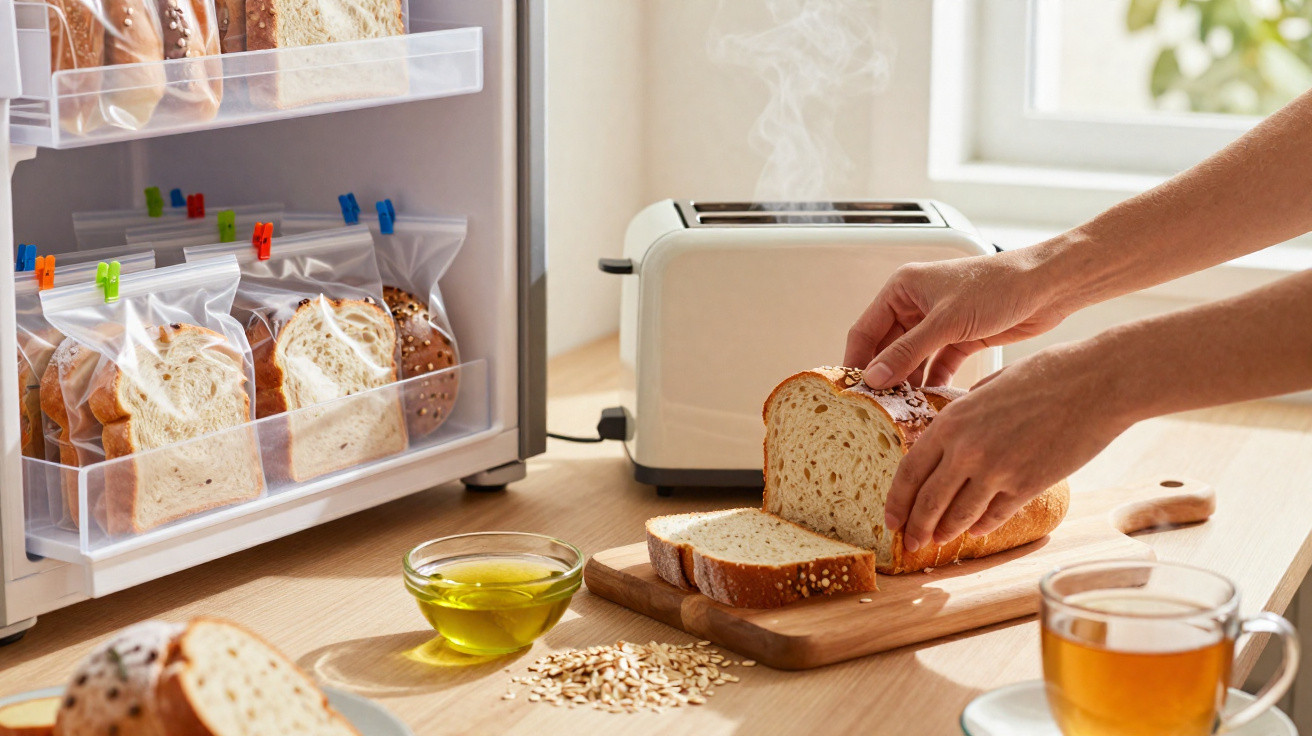
Sounds practical.
Many households save slices from the bin in this way. Yet this everyday habit raises genuine questions: what happens to nutrients, germs, flavour and blood sugar? And how can it be done safely, without a soggy crust or breakfast-time disappointment?
Why so many households freeze bread
Daily life often creates surplus bread: family meals, changing appetites and bakery offers. The freezer halts this cycle and saves money. A frozen piece of bread remains versatile: a sandwich today, croutons tomorrow. The health concern is not the freezing itself, but how the slices are handled, kept hygienic and brought back to life.
Freezing temperatures halt the growth of most germs, but they do not kill them. Safety depends on the bread's condition at the start and on how it is defrosted.
What freezing does to nutrients, texture and hygiene
Effects on vitamins, minerals and fibre
Freshly baked bread provides complex carbohydrates, B vitamins, minerals including magnesium and potassium, and fibre. Freezing largely preserves these nutritional values. Noticeable losses are more likely to result from lengthy storage at room temperature or exposure to air than from −18 °C. Wholemeal and sourdough breads retain their fibre content, while gluten remains unchanged.
Everyday microbiological risks
Freezing preserves food, but it cannot correct earlier mistakes. Packing bread while it is still warm traps condensation. Damp pockets can encourage mould to develop later. Unsealed packaging absorbs odours and attracts ice crystals. Leaving bread to defrost for too long in a warm kitchen creates temperature zones in which surviving microbes can become active again. Visible mould, a “stringy” coating or a sour, musty smell means it should be discarded.
Freeze only fully cooled, clean bread in tightly sealed bags. Defrost it quickly and in a controlled way – ideally in the fridge, followed by brief heating.
Blood sugar, starch and the surprising toasting effect
As bread cools, some of its starch forms new links. This creates more resistant starch, which the small intestine breaks down less effectively. Small studies found lower rises in blood sugar when white bread had first been frozen and was then toasted. The size of the effect varied, but the increase was generally considerably lower than with fresh, untoasted bread. This may help people with sensitive glycaemic responses, but it is not a substitute for a balanced diet.
| Method | Expected effect on glycaemia | Texture/flavour |
|---|---|---|
| Fresh, untoasted | Highest rise | Soft crumb, crisp crust (soon after baking) |
| Defrosted at room temperature | Slightly lower | Crumb can become somewhat rubbery, crust softer |
| Defrosted and toasted | Significantly lower | More toasted flavours, better crust |
How to freeze bread properly
Following a few simple steps improves flavour, safety and flexibility.
- Allow the bread to cool completely before packing it.
- Cut it into slices or individual portions, so that only what is needed has to be defrosted.
- Pack it tightly: use double freezer bags or firmly sealed containers, removing as much air as possible.
- Write on the date and check quality after no more than 2 months; storage for up to 3 months is possible, although flavour loss is often greater.
- Defrost in the fridge or promptly at room temperature (in under 2 hours).
- For improved texture, warm it briefly in the oven (180–200 °C, 5–10 minutes) or use a toaster.
- Never refreeze bread that has been fully defrosted.
- Dispose of bread with visible mould, “strings”, or a musty odour.
A short heating step after defrosting improves the crust while also reducing the microbial load on the surface.
Which breads are especially suitable for freezing
Sliced loaves, baguette pieces and bread rolls freeze reliably. After defrosting, sourdough often has the most stable crumb because its natural acidity keeps microflora in check. Wholemeal loaves benefit from toasting, as their moisture can otherwise create a “rubbery” texture. Very moist speciality breads with a seeded crust should be packed particularly tightly to prevent freezer burn.
Advice for vulnerable groups and children
Pregnant people, older adults and anyone with a weakened immune system should preferably defrost bread in the fridge and heat the slices before eating. For young children, thin slices that have been lightly toasted and topped with a soft spread are suitable to reduce choking risk. People with coeliac disease should freeze gluten-free breads in small portions to avoid contact with crumbs in the kitchen.
Mistakes that ruin bread in the freezer
- Packing warm loaves: condensation turns into ice and can promote mould later.
- Using thin single-use bags without a second layer of protection: odour absorption and freezer burn are likely.
- Defrosting on a radiator: warm on the outside and cold in the middle – an ideal environment for germs.
- Running the microwave for too long: the crumb becomes tough and the crust leathery.
Everyday planning: portion bread cleverly
Slice loaves into pieces 12–14 mm thick. Pack two to four slices together. Label bags with the type and date, for example “wholemeal sourdough 02/26”. Lay the bags flat so the slices separate more easily. Rotate your stock by using the oldest bread first.
Mini recipe ideas for defrosted bread
- Oven croutons: Cut slices into cubes, toss with olive oil and garlic, then roast for 8 minutes at 200 °C.
- Crispy bread for salad: Reheat halved bread rolls for 5 minutes, then top with tomatoes and herbs.
- Savoury French toast: Dip bread in beaten egg with milk, fry it, and serve with vegetables.
Background: what happens to starch as bread cools
During baking, starch swells. As the bread cools, the chains realign, and part of the starch becomes less accessible to digestive enzymes. This proportion is called resistant starch. A cycle of cooling and reheating increases it moderately. The effect remains variable because the bread type, crumb moisture and heating time all play a part.
Energy, money and environmental impact
A household freezer uses electricity, but it can prevent food waste. Freezing and portioning bread in good time reduces waste and shopping journeys. A brief spell in the oven uses energy; a toaster is more efficient per slice. Plan reheating in batches, such as for several people, to make better use of the heat.
Freezing bread protects nutrients, makes daily life easier and may reduce the blood sugar rise – provided hygiene and the defrosting routine are right.
Definition: Freezer burn refers to dried-out, greyish patches caused by the sublimation of ice. Although it looks unappealing, it is usually not harmful to health. Tight packaging prevents it.
Practical example: A 750-g loaf cut into 24 slices makes twelve two-slice packs. With two toasting cycles on each weekday, this covers breakfast for a family of four without needing to visit the bakery – and without throwing away a single slice.

















Comments
No comments yet. Be the first to comment!
Leave a Comment