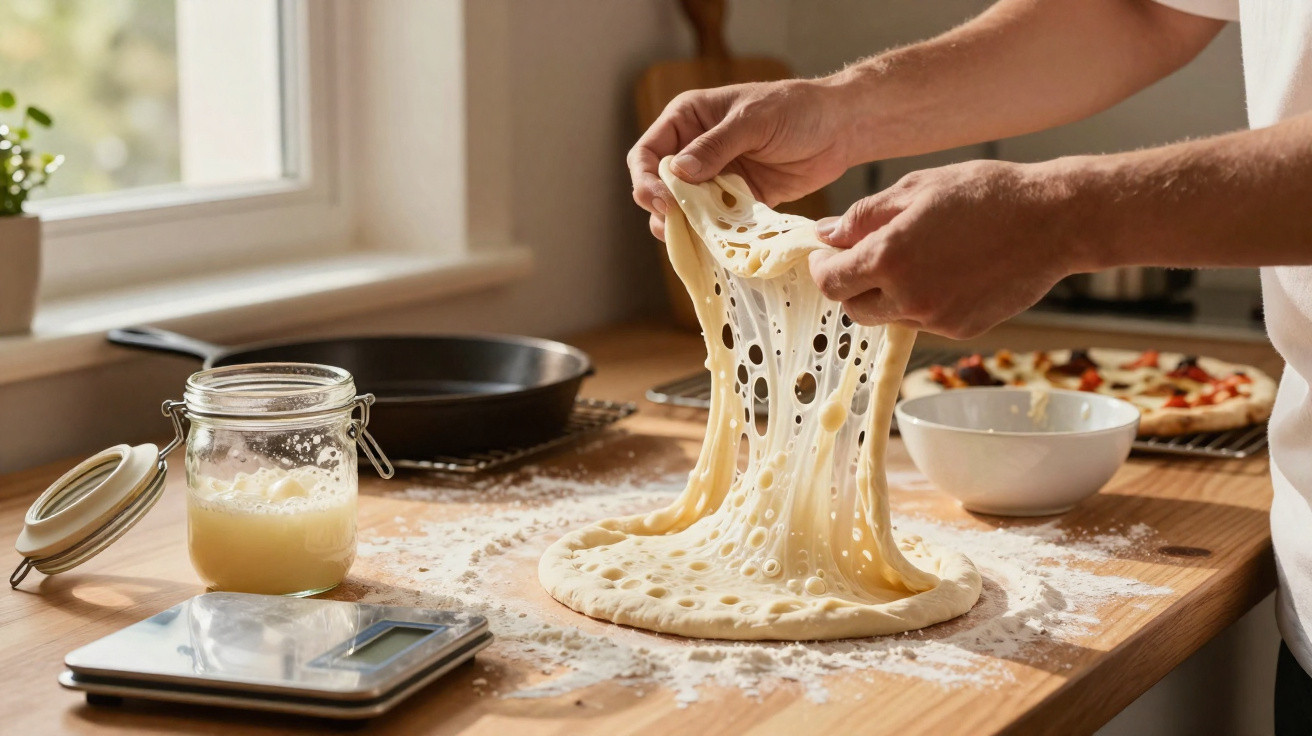
Sarah Martinez believed that, after fifteen years as a food blogger, she had encountered every possible pizza dough recipe. But on a quiet Tuesday afternoon in March 2023, she came across a TikTok from home baker Emma Chen that shifted her view entirely. In the clip, Emma stretched an exceptionally light, cloud-like pizza dough: sheer enough to see through, but still strong enough to support plentiful toppings without splitting. The comments were exploding. “This is actual magic,” one viewer wrote. Another commented, “I’ll never buy pizza again.” Its remarkable appearance was not the only reason for the excitement. The real difference was a secret ingredient that had been there in plain sight all along.
The moment everything changed for home pizza makers
Emma Chen’s sourdough pizza dough recipe did more than become a viral hit: it triggered what food lovers now describe as “the great pizza awakening.” Her first video gained 12 million views within weeks, leading to thousands of reaction clips and changing home kitchens around the world. The method brought together active sourdough starter and high-hydration techniques that professional pizzaiolos had closely guarded for decades.
What followed took everyone by surprise. Home bakers using Emma’s approach described an unprecedented result: they truly could not return to ordinary pizza dough. Maria Santos of Portland put it neatly in her review: “I made this on a whim last Sunday, and now my family refuses to order pizza delivery anymore.” Similar accounts continued to fill the comments, from families abandoning their regular pizza-night takeaways to friends requesting the recipe and neighbours asking about the irresistible aromas drifting from home kitchens.
There is no real mystery behind the science. Sourdough fermentation develops complex flavour compounds that standard yeast cannot replicate. Its natural acids break down gluten in a way that creates a highly digestible, flavourful crust with the sought-after air pockets. The wild yeasts and bacteria in sourdough starter work slower than commercial yeast, giving flavours 24-48 hours to develop rather than only a few hours.
Why this sourdough pizza dough recipe became everyone’s obsession
Emma’s brilliance lay not in inventing an entirely new method, but in making a complicated process straightforward. Her recipe uses only four ingredients: sourdough starter, bread flour, water and salt. Timing and technique supply the magic. Everything is mixed the evening before, left to bulk-ferment at room temperature, then cold-fermented in the fridge for at least 24 hours.
Most sourdough pizza recipes, frankly, put people off with countless stages and professional jargon. Emma removed the unnecessary parts and concentrated on what matters most. She demonstrated that you don’t need a wood-fired oven or fancy equipment; patience and a reasonably good domestic oven heated to its maximum setting are enough. People most often go wrong by hurrying the process or adding too little starter, which produces a dense dough with little flavour.
Emma’s stretching technique was what finally won people over. She showed that properly fermented sourdough pizza dough becomes almost elastic and can be drawn out paper-thin without ripping.
“The first time I achieved that windowpane effect with my sourdough pizza dough, I actually gasped out loud. It felt like I’d unlocked some ancient secret that had been hiding in my kitchen all along.”
The key details that make Emma’s recipe reliable are:
- An 80% hydration ratio for the ideal texture
- An active starter that doubles in 4-6 hours
- At least 24-48 hours of cold fermentation
- A rest at room temperature before shaping
The ripple effects nobody saw coming
This development extended beyond pizza. Food communities began telling stories of Emma’s recipe restoring their enthusiasm for cooking, bringing families together at the dining table and even encouraging people to keep sourdough starters for the first time. Nearby flour mills saw higher sales of quality bread flour, while pizza stone makers struggled to meet demand. The impact spread much further than anyone anticipated.
| Key point | Detail | Value for the reader |
|---|---|---|
| Fermentation time | 24-48 hours cold fermentation | Builds complex flavours that cannot be created quickly |
| Digestibility | Natural acids break down gluten | Gentler on sensitive stomachs than commercial yeast dough |
| Versatility | Works with any toppings or cooking method | Suits personal preferences and equipment limitations |

















Comments
No comments yet. Be the first to comment!
Leave a Comment