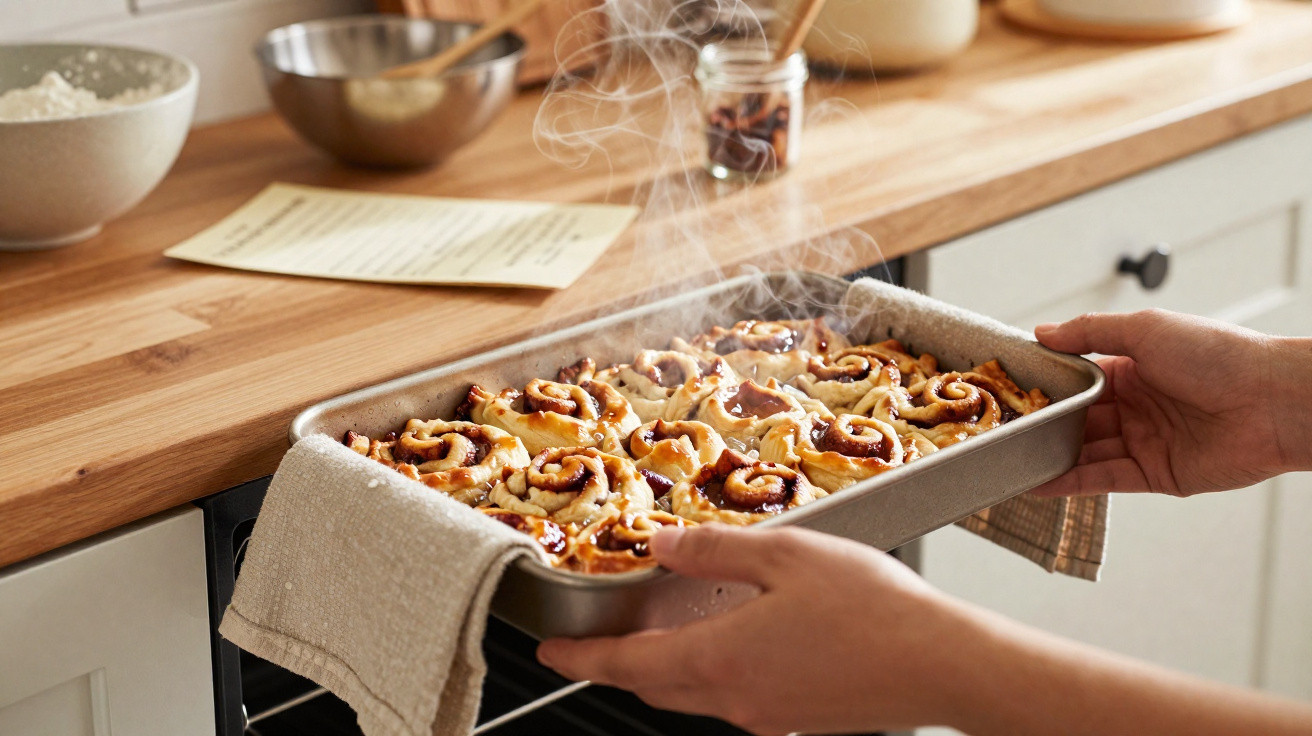
The oven door mists over, and the kitchen suddenly seems more intimate, more secure. Beyond it, your phone vibrates on the worktop, the group chat is debating something trivial, and your inbox sits in another room as a quiet source of dread. Here, though, there is only a well-used baking dish, a wooden spoon and the gradual, gently sweet scent of food changing in the oven.
You can no longer tell whether the day has been good or bad. What you do know is that, in roughly 35 minutes, you will take out a golden tray of comfort that does not ghost you, cancel plans or turn up lukewarm.
This warm baked recipe offers the very best kind of reliability.
That is precisely why we return to it.
The quiet strength of a dependable baked recipe
There is a particular release of tension in your shoulders when you begin a recipe you know you can trust. You reach for the same marked-up printout or open that familiar screenshot, and your mind says, “Okay, we’ve got this.” The wider world may be in disarray: the news, the bills, the unexpected calendar alerts. This recipe, however, does what it should.
You recognise the batter’s appearance when it is ready. You know that the left side of your oven runs slightly hotter. At the 20-minute mark, you can practically predict the aroma to the second. That degree of certainty feels unusually scarce these days.
The baking dish becomes a modest, edible assurance.
Imagine a Tuesday evening that has felt as though it lasted 36 hours. You arrive home late, flicking through takeaway apps and growing irritated by delivery estimates and surge charges. Then you remember the “always-works” recipe saved in your browser bookmarks: a straightforward baked chicken and potato dish you have prepared at least fifteen times.
You put everything into a dish with olive oil, garlic, salt, pepper and a squeeze of lemon. There are no measuring spoons and no fuss. While it cooks, you get into comfortable clothes, reply to one email and pour yourself something chilled. When you finally sit down, the kitchen smells as though somebody has been looking after you all afternoon.
No one has to know that it required only ten minutes of real work.
Our minds have good reason to hold on to dependable recipes. Cooking is among the few daily rituals in which what you do produces a visible, satisfying reward with relative directness. You combine, bake and wait. Life itself seldom follows such a tidy sequence.
That is why a single well-tested warm baked recipe can act as a foundation for your life. While everything else shifts, the dish emerges almost identically each time. There may be small differences, of course, but the essential feeling remains.
Let’s be honest: no one truly makes this every day. Still, simply knowing that this small anchor is part of your repertoire can alter how you approach difficult weeks.
What makes a warm baked recipe feel safe
What, then, gives a baked recipe its sense of dependability? Usually, it is about its structure rather than what is currently fashionable. Think of minimal ingredients, forgiving textures and instructions that do not demand a qualification in pastry science. It should be a dish that withstands a slightly distracted cook while still delivering comfort.
Consider a familiar example: you assemble a tray bake with vegetables, a protein and a basic sauce. If your oven is a touch too hot, the edges simply caramelise. If you leave it five minutes longer, it remains perfectly good. If carrots become sweet potatoes, nobody lodges a complaint.
A safe baked recipe gives way rather than failing. That is its entire secret.
One reader described her “rainy-day bake”: an unpretentious banana bread she has made since university. It takes three overripe bananas, melted butter, brown sugar and one bowl before going into the tin. She has baked it in four flats, in three cities, during one break-up and two changes of job.
When her father became ill, she prepared it in his kitchen every Sunday afternoon. “The house always smelled the same,” she said. “Even when everything else felt completely different.” Her siblings would drift in, cut themselves a warm slice and, for ten minutes, the conversation would become light again.
That loaf was never elaborate. It simply appeared week after week when people needed something warm and soft to hold.
There is sound reasoning behind the way these recipes turn into emotional safety nets. Warm bakes sit at the meeting point of routine and reward. Their stages can be repeated, their timings are familiar, their result is largely assured, and their reward involves every sense.
You notice the browned edges, hear the soft crackle as it leaves the oven, feel its warmth through an oven glove, breathe in the steam and taste the first edge piece, always a little too hot. Your nervous system takes this in as: “We’re okay, we’re home, we’ve done this before.”
In a world that constantly asks you to upgrade, optimize, and reinvent, a simple, steady recipe quietly insists that “good enough” can be deeply, soothingly good.
Creating your own go-to warm baked recipe
If you do not yet have a reliable recipe of your own, you can create one to suit your life. Begin with a base format that matches the way you eat: a tray-bake dinner, baked pasta, fruit crumble, loaf cake or roasted vegetables topped with halloumi. Choose something you already want most on your hardest days.
Then simplify it. Target 6–8 main ingredients available in nearly any supermarket, alongside cupboard staples such as oil, salt and pepper. The technique ought to be easy enough for a half-distracted evening: chop, season, arrange in a dish and bake. It should not need continual attention.
Try it on an ordinary weeknight rather than saving it for a day when you feel wonderful. Find out whether it still feels generous when you are exhausted.
When creating a “signature” recipe, people often make it too complicated. There may be too many spices, excessively exact timings, three types of flour or a sauce requiring a blender at 10 p.m. At that point, the recipe no longer feels trustworthy; it feels like a task.
Allow yourself to take shortcuts here. Choose frozen vegetables if chopping is what puts you off. Purchase pre-grated cheese. Line the dish with baking parchment so that it barely requires washing. The purpose is not to impress people on social media. It is to support your future self, looking through the oven door and suddenly feeling less alone.
If a recipe feels achievable only when you are at your most capable, it is not your dependable recipe yet.
Sometimes the most nourishing recipes aren’t the ones that win awards, but the ones that quietly keep the week from falling apart.
- Begin with a flexible base
Think in terms of a template rather than a rigid set of rules. A tray of vegetables and protein, a basic batter or uncomplicated layered pasta can all accommodate substitutions based on what is in your fridge. - Choose repeatable flavours
Settle on 3–4 seasonings that you already enjoy and keep at home: perhaps garlic, smoked paprika, lemon and chilli flakes. Your first bite should taste familiar, like home. - Match the timing to your actual life
If you are generally ravenous at 7 p.m., a recipe that needs 75 minutes in the oven will only frustrate you. Look for 25–45 minutes of baking time and under 15 minutes of preparation. - Accept “good enough” doneness
A reliable bake tastes good whether it is marginally underdone or overdone. Choose something saucy, cheesy or moist rather than delicate or exceptionally thin. - Make your own scruffy notes
Write “add more salt”, “rotate pan at 20 mins” or “best with extra cheese” directly on the recipe. That untidy commentary in the margins is where dependability begins.
A baking dish in the oven when the day unravels
There will be evenings when you put this dish together while replaying a challenging conversation in your mind. There will be days when you cannot quite recall what you accomplished, only that you are tired. Even then, you will line the dish, add the oil, scatter the salt and slide it into the heat.
On those occasions, the ritual means more than the individual flavour notes. You will look through the oven door once, then twice, without any true reason. You will press a fork into the top despite having made it a dozen times and knowing precisely how long it needs. You are not really inspecting the food. You are looking for something dependable in the world.
A warm, dependable bake will not miraculously fix your life. It does offer one small, indisputable success: you began something, saw it through, and now your home smells of effort becoming comfort. The people around you may wander into the kitchen, drawn by the scent. Or you may eat by yourself, standing at the worktop with a fork straight from the dish.
Both moments matter. Both are valid. A tender, well-seasoned mouthful of hot food can become a conversation in itself, particularly when words feel too difficult to carry.
Sometimes, reliability is the most overlooked flavour on the plate.
Over time, you may adjust the recipe, increasing the salt, reducing the cooking time by five minutes, replacing broccoli with green beans and then changing it back again. Its centre will remain unchanged: a dish that accommodates your timing, suits your cravings and finds you exactly as you are.
One day, you may serve it to someone who asks for the recipe. You will send them a photograph of your stained, partly inaccurate notes and feel a little self-conscious. Yet that is exactly the point. It is not a showpiece; it is a piece of life.
And further down the road, when their own day comes apart, your warm baked recipe will be in their oven: as reliable as ever, quietly humming in the background while life continues.
| Key point | Detail | Value for the reader |
|---|---|---|
| Choose a flexible base | Select straightforward formats such as tray bakes, crumbles or loaf cakes with ingredients that can be swapped | Lowers stress and food waste while working with whatever is in the fridge |
| Keep the method forgiving | Use brief preparation, a moderate baking time and textures that tolerate small timing mistakes | Keeps the recipe dependable on hectic, low-energy days |
| Personalise over time | Include handwritten notes, favourite spices and timing adjustments | Changes a general recipe into a comforting, go-to ritual |
FAQ:
- Question 1 What’s an example of a simple dependable warm baked recipe I can start with?
- Question 2 How many times should I cook a recipe before calling it my “go-to”?
- Question 3 What if my oven is unreliable or very old?
- Question 4 Can a dependable recipe still be “healthy”?
- Question 5 How do I keep this ritual from turning into another chore?

















Comments
No comments yet. Be the first to comment!
Leave a Comment