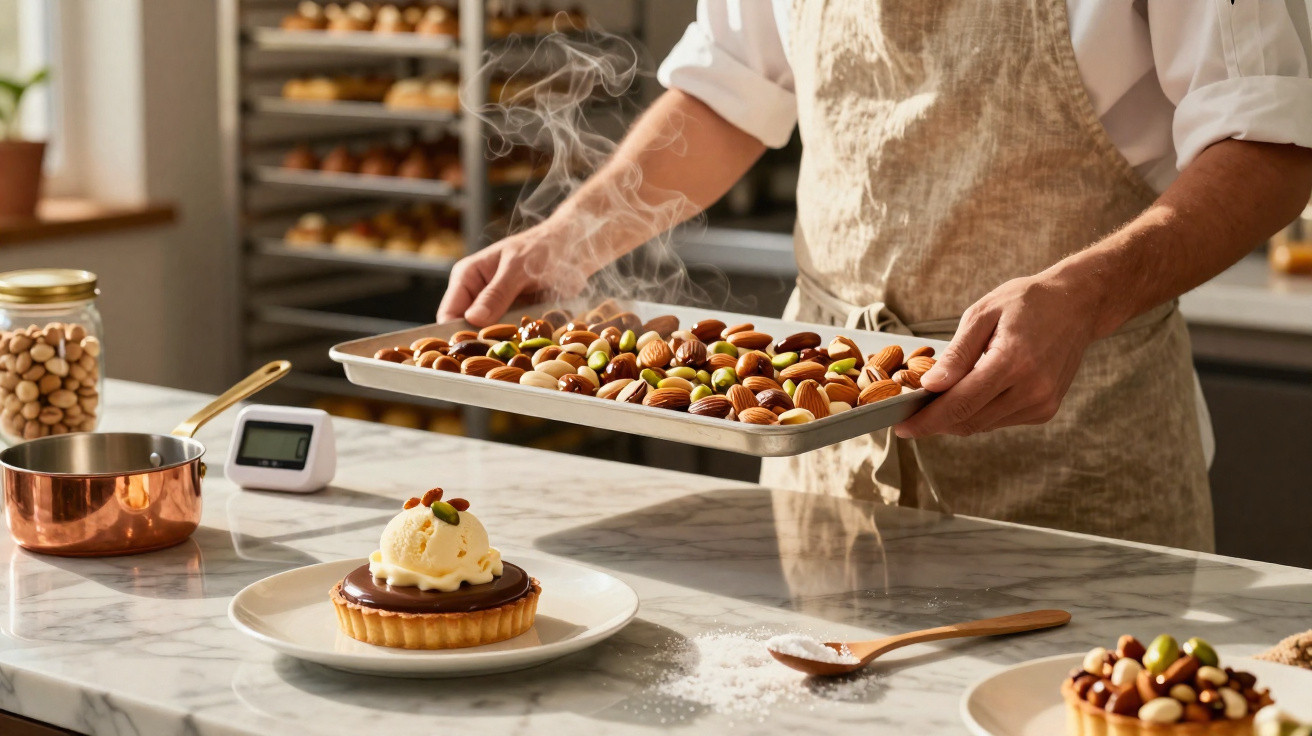
The first time I truly grasped the value of toasted nuts was not from a cookbook, but in a bustling restaurant kitchen moments before service. A young pastry chef put a tray of pale almonds into the oven, then returned to whipping cream as though he had started the countdown on a bomb. Four minutes later, he pulled out the tray, gave it a shake and returned it to the oven. There was no recipe to consult, only his instincts and sense of smell. When the nuts finally came out, that corner of the kitchen felt transformed: richer, warmer, as if a bakery door had been opened on a winter’s day. Ten minutes later, those very almonds were sprinkled across a chocolate tart that had suddenly become sophisticated and faintly mysterious.
On paper, it seemed like an insignificant instruction.
In practice, it was a subtle piece of kitchen magic.
The small step that quietly transforms everything
You know how it goes: a recipe instructs you to “add chopped walnuts”, so you simply add chopped walnuts. Perhaps they come straight from the packet, perhaps from the back of the cupboard after gathering a little dust. The pudding turns out well enough, everyone eats it and the evening carries on. Then, one day, someone serves a cake made with the same nuts, except theirs are darker and fragrant-the sort you can smell before the plate reaches the table. All at once, the icing seems fuller, the crumb more indulgent, and you start wondering whether they splashed out on expensive ingredients. The spoiler is that they probably gave a frying pan 7 minutes over a medium heat.
Imagine a plain banana loaf cooling on a wire rack. As you cut into it, steam rises and the walnuts within are simply there: pale, subdued and nearly forgettable. Now imagine that same loaf with walnuts toasted beforehand. They are darker, flecked with fine golden edges, and offer a sharp snap when bitten. Nothing else about the loaf has changed, yet its flavour seems broader, as though both bass and treble have been turned up. This is what restaurant pastry chefs count on: they take an ordinary walnut or hazelnut and amplify its character before it ever reaches the batter. It is not about showing off. It is about not allowing an ingredient to murmur when it has the potential to sing.
The science behind the move is remarkably technical for something so straightforward. As nuts heat up, their natural oils begin to loosen and circulate, coating the surface and transporting aromatic compounds to your nose. Meanwhile, the nut’s sugars and amino acids enter Maillard reaction territory: the browning process responsible for toast tasting like toast and coffee tasting like coffee. Raw nuts are gentle and somewhat starchy; toasted nuts are caramelised, buttery and more deeply flavoured. It is rather like ageing cheese or wine, except it happens in a frying pan over medium heat while you check your phone. The nuts retain their shape, but their chemistry has made a quiet leap forwards.
How chefs toast nuts without burning them
Professional kitchens approach it with little romance: nuts are arranged in one layer on a metal baking tray, placed in a hot oven and timed with almost mechanical accuracy. You can recreate the technique at home in an oven heated to 170–180°C, with 5 to 10 minutes of patience. Arrange the nuts without overlap, then roast them until they deepen slightly in colour and smell like the bakery corner in December. Shake the tray once or twice to prevent the edges from cooking too quickly. Next comes the crucial part: transfer them from the hot tray as soon as they are ready. They will continue to toast against the hot metal, which is how “perfectly golden” turns into “why do these taste like ash?” only two minutes later.
A frying pan is equally effective if that is your preference. Put the nuts into a dry pan over medium heat, stirring or shaking them frequently. You are looking for a soft sizzle rather than an aggressive crackle. As soon as the colour becomes uneven or you detect the slightest bitter scent, abandon the mission and take the pan off the heat. We have all had that experience of walking away “just for a second” only to return to blackened pine nuts that cost more than your last cinema ticket. That painful waste explains why chefs watch their trays like hawks. They understand how rapidly nuts pass from “almost ready” to “spoilt”.
There is a gentle emotional element to this technique too: toasting nuts is a small gesture of care, even if nobody can identify what you have done differently. Friends may only say that your brownies taste “more chocolatey” or that your ice cream seems “rounder”. In reality, they are tasting roasted fat and heightened aroma. One pastry chef I spoke to put it simply:
“Toasting nuts is like asking them who they really are. Raw, they’re shy. Toasted, they finally introduce themselves.”
And, being practical, chefs follow a handful of straightforward principles:
- Toast nuts before chopping them, as this helps them brown evenly.
- Let them cool completely before stirring them into batter or cream.
- For an exceptionally crisp texture, toast them a little darker than seems necessary… but stop before they turn bitter.
- Keep any leftover toasted nuts in an airtight jar and use them within a week for the best flavour.
- If you are unsure, taste one every minute near the end. Your nose is your most reliable timer.
The understated upgrade missing from homemade desserts
Once you have spotted the difference, it becomes impossible to ignore: toasted almonds over a fruit crumble, golden pistachios on pistachio gelato, hazelnuts that genuinely smell of Nutella before any sugar is added. You begin to see that the gap between a “nice dessert” and “wow, can I have the recipe?” often lies in these small, almost tedious-looking details. Let us be honest: nobody does this without fail every day. Life is untidy, the sink is full and, on some Tuesday nights, walnuts go straight from the packet into the batter because that is what getting through the evening looks like.
Yet when you are baking for a birthday, a date or a family tradition you quietly want to preserve, this is one of those techniques worth taking the time over.
| Key point | Detail | Value for the reader |
|---|---|---|
| Toasting intensifies flavour | Heat triggers Maillard reactions and releases aromatic oils | Turns everyday desserts into bakery-level treats |
| Timing and temperature matter | 5–10 minutes in the oven or a few minutes in a frying pan, with constant attention | Lowers the chance of burning expensive nuts and wasting ingredients |
| Use toasted nuts strategically | Toast before chopping, cool fully and add last for crunch and aroma | Creates better texture, fuller flavour and more professional-looking desserts |

















Comments
No comments yet. Be the first to comment!
Leave a Comment