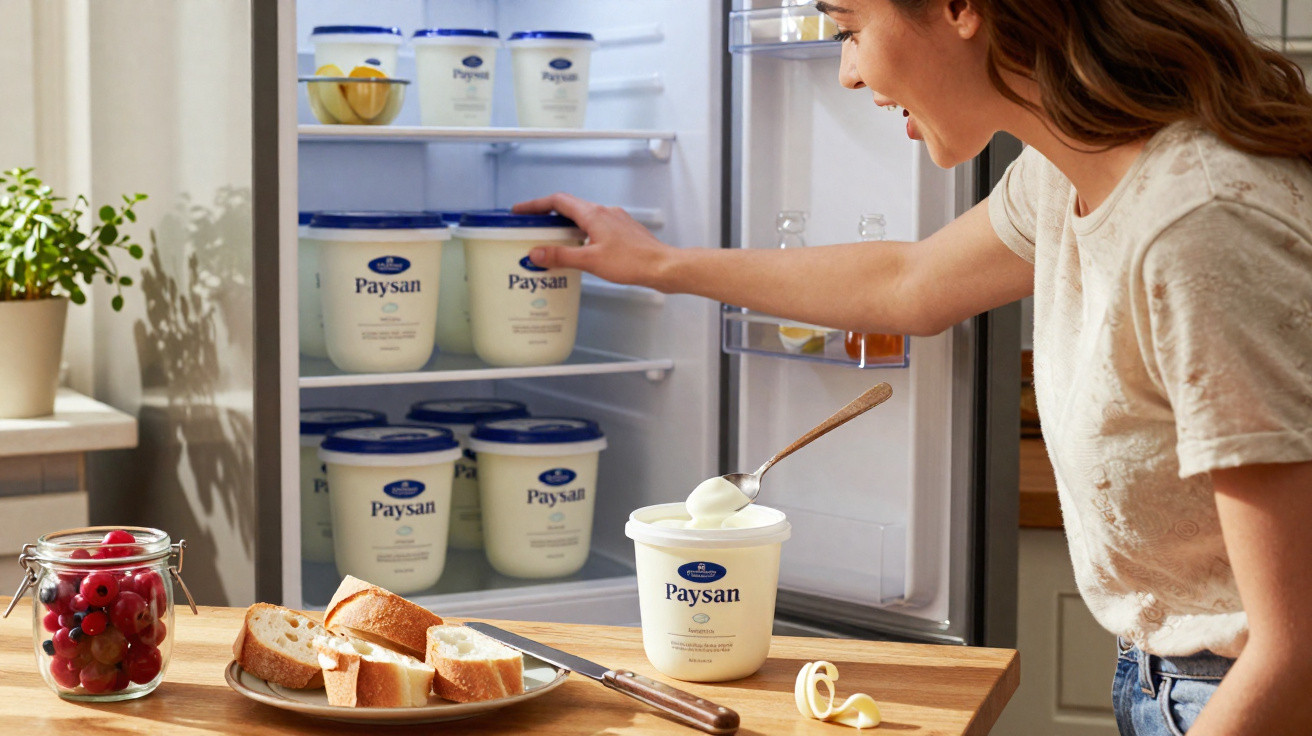
Anyone who shops regularly in supermarkets will already know the logo from the butter and cheese aisle. French brand Paysan Breton is now targeting another fiercely contested part of the chilled cabinet, with an entirely new range of yoghurts and cream-cheese-style dairy products designed to make one thing clear: this is no longer just about butter, but the creation of a full product portfolio.
From butter staple to yoghurt brand: the strategy behind the shift
Paysan Breton has long been regarded in France as a dependable name for butter and traditional dairy products. According to the company, around 18 million households already keep the brand in their fridge. It now intends to use that existing trust to establish itself in the rapidly expanding fresh dairy-dessert category.
The brand is entering the chilled aisle with no fewer than seven new products – a bold move in an overcrowded market.
This is not an impulsive decision, but part of a defined strategy: generate more value for its own dairy farmers, strengthen its retail presence and take on a broader role in consumers’ everyday routines. Rather than appearing only on buttered bread, Paysan Breton aims to feature at breakfast, as a snack and at dessert time.
The company’s marketing team says that development centred on three guiding principles: trust, transparency and minimal processing. Recipes were to remain short, the origin of the milk clearly stated and additives largely excluded.
Seven new products at once: what the Paysan Breton range includes
After around two years of development, Paysan Breton is launching a complete range. Its focus is on creamy whole-milk yoghurts and varieties most comparable to quark or cream-cheese-style dairy products.
The new products are built around three key characteristics:
- whole milk as the base, enriched with cream for added smoothness
- short ingredient lists without colours or preservatives
- milk from Breton farms linked to the company through direct supply relationships
The aim is to create a range that stands apart from heavily flavoured desserts. The company describes its approach as “simple and minimally processed”. Shoppers should be able to understand the ingredient list within seconds of turning over the pot.
Family-sized pots rather than single servings: challenging an established buying habit
The packaging represents a notable break from familiar habits. Paysan Breton is dispensing entirely with individual pots and relying almost exclusively on larger family packs containing four to six portions.
The producer deliberately wants to move away from the “single-use snack” towards sharing food at the table – and producing less waste.
That brings some risk for retailers, as single pots and four-packs currently dominate the chilled aisle. Yet it also presents an opportunity: families, shared households and couples who eat together can cover several servings with one pot. If leftovers are sealed properly, this can cut both food waste and plastic use.
| Feature | Typical yoghurts | Paysan Breton range |
|---|---|---|
| Portion size | Individual pots, small multipacks | Family pots with 4–6 portions |
| Ingredient list | Often includes flavourings and stabilisers | Short, with no colours or preservatives |
| Positioning | Snack, “on the go” | Sharing at the table, multiple uses |
Which varieties are arriving – and what they are for
The yoghurt range launches with several flavours intended for different everyday occasions. The emphasis is on straightforward recipes that taste like familiar dairy food rather than experimental desserts.
Plain natural yoghurt for breakfast and cooking
The flagship option is a natural yoghurt made with whole milk and cream. With its mild flavour and creamy texture, it is designed to work eaten on its own as well as a base for muesli, bowls, dressings or sauces.
This is where the everyday focus is particularly clear: many households want one product that suits granola in the morning, becomes a dip for roasted vegetables at lunchtime and rounds off the day as a dessert with a little honey. Paysan Breton is seeking to build precisely this all-round image.
Vanilla and red fruits for sweeter moments
For those looking for something sweeter, two more flavoured options are heading to the chilled cabinet:
- Vanilla from Bourbon pods for a classic, relatively gentle sweetness
- Red-fruit yoghurt with strawberry, raspberry and blackberry, deliberately centred on fruit flavour rather than artificial flavourings
The message is that shoppers buying fruit yoghurt should genuinely be able to taste the fruit, rather than mainly sugar or artificial notes. Market researchers have observed for years that health-conscious families in particular are increasingly paying attention to this.
Why now? A look at the market, trends and opportunities
The fresh dairy market is crowded, but consumer behaviour is changing at the same time. Many shoppers still buy yoghurt, while wanting greater transparency: where does the milk come from? How many additives does it contain? What part does sustainability play?
The new range is intended to bring the image of “honest ingredients, clear origins” directly into the chilled aisle – a counterpoint to heavily engineered recipes.
There is another consideration for Paysan Breton. The dairy sector faces price pressure, while farmers contend with fluctuating earnings. Higher-value products with clearly stated origins can support higher prices, ideally benefiting producers as well.
At the same time, many households are developing a stronger appetite for simple, familiar products and moving away from highly complicated snacks with long ingredient lists. This is exactly where the brand intends to position itself: less “food tech”, more traditional dairy flavour.
What consumers gain – and what they should consider
Paysan Breton’s arrival gives shoppers a wider selection in the fresh dairy category. Those who already favour larger packs may benefit in several ways:
- more economical per-portion prices for larger packs
- considerably less packaging waste than with multiple individual pots
- flexible use in cooking, desserts and snacks
Larger pots do, however, require some planning. Once opened, their contents should be used promptly and served hygienically to prevent germs multiplying. Using clean spoons, resealing the pot quickly and keeping the fridge at around four degrees Celsius are the essentials.
Anyone wishing to use the yoghurt more creatively could, for example:
- prepare overnight oats with oats, nuts and fruit
- turn it into a dip for raw vegetables with herbs, garlic and lemon
- use it as the base for a light sauce with baked potatoes or grilled vegetables
- whip it with a little sugar and vanilla into a quick cream for cake or fruit salad
Perspective for German-speaking markets
In German-speaking markets, Paysan Breton has so far been more associated with the delicatessen and speciality-food aisle. However, the new range clearly signals a possible direction of travel: brands that once concentrated heavily on individual classics are becoming full-service providers for the fridge.
For consumers in these markets, it is worth looking beyond the familiar. Trends such as larger multi-person pots, short ingredient lists and closer links to farming businesses could also gather pace among German dairies. Those who watch for such signals can quickly distinguish products that rely only on appearance from those that genuinely change their production methods and recipes.
Overall, Paysan Breton’s move represents an intriguing test: how far will trust in a well-known butter brand extend when it suddenly appears in the chilled aisle as a yoghurt producer? Shoppers’ baskets over the coming months will provide the answer.

















Comments
No comments yet. Be the first to comment!
Leave a Comment