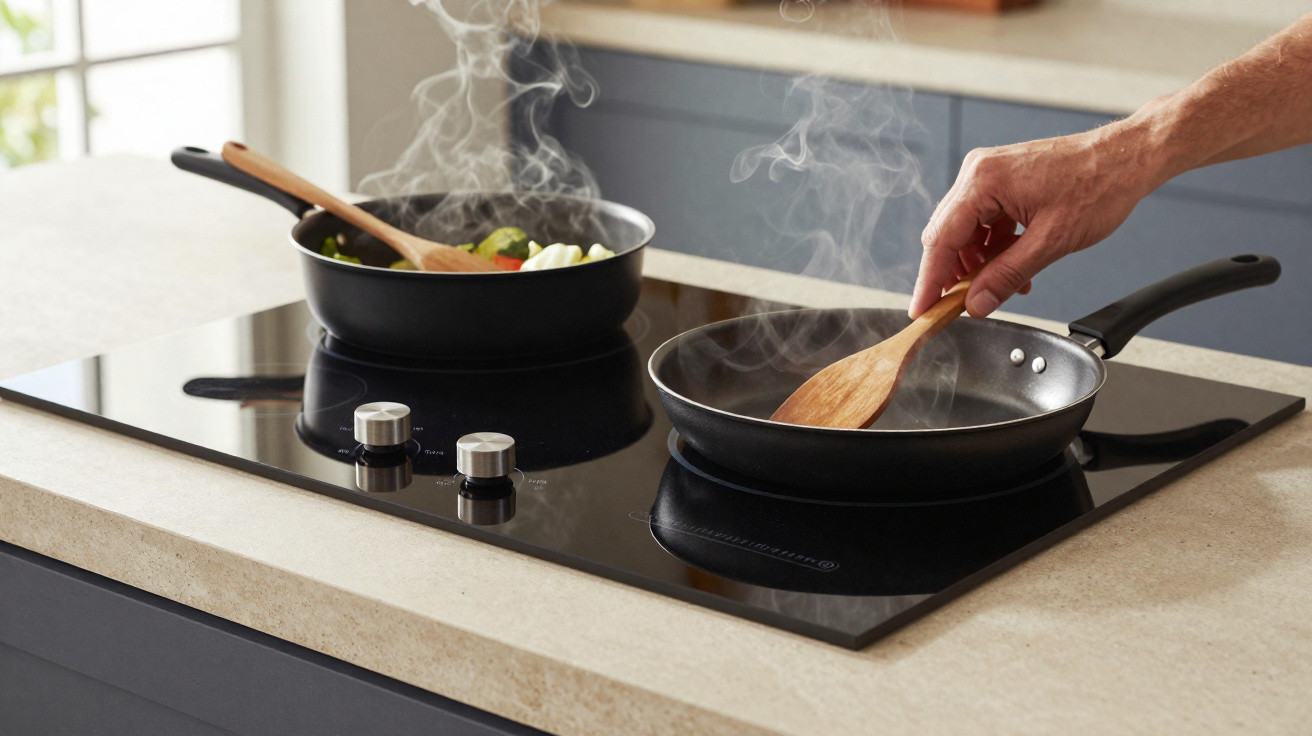
A new induction hob can look unexpectedly blank. Instead of four circles or clearly marked cooking zones, there may be a single sheet of dark glass with only discreet controls at the edge. The trick is not that the whole surface heats up: it is that some hobs can recognise pans across a much larger usable area than a conventional model.
Known as full-surface, zoneless or free-placement induction, this type of hob can make cooking with a stockpot, frying pan and small saucepan feel less restricted. It is not automatically the best choice for every kitchen, however, and the differences between models are important.
What is different from a conventional induction hob?
A conventional induction hob has a fixed number of heating zones. These may be shown as circles, rectangles or subtle markings beneath the glass. For the best results, pans need to sit reasonably centrally over the relevant zone.
A flexible or full-surface design uses an arrangement of coils beneath the glass to heat cookware placed within its stated active area. Depending on the model, it may detect the size and position of a pan, allow zones to be joined together, or offer more freedom to place several pans side by side.
That does not mean every part of the glass is a cooking area. The controls, outer edges and spaces between active sections may not detect cookware. The number of pans that can be used at once also varies.
The useful difference is not an invisible heat source: it is more freedom to arrange suitable pans where they are practical.
Why these hobs look almost unmarked
The minimalist finish is a major part of the appeal. Without prominent cooking rings, the hob can blend into a dark worktop or sit neatly in a contemporary kitchen with flat-fronted cupboards.
Most still have touch controls, usually at the front. Some display illuminated controls only when switched on, while others show pan-position or heat indicators when cookware is detected.
A plain surface does not mean less cleaning. Black glass shows fingerprints, water marks, limescale and dried-on food readily, particularly in hard-water areas. The advantage is mainly visual: there are fewer printed outlines interrupting the surface.
How flexible induction cooking works
Induction creates a magnetic field beneath the glass, heating compatible cookware rather than a conventional electric element. The base of the pan becomes hot and transfers heat to the food; the glass underneath can then become hot from contact with the pan.
On some flexible hobs, a setting can follow a pan when it is moved. On others, you must select the new position or zone using the controls. Do not assume that one model works like another: check the manual and, if possible, ask for a live demonstration.
Check your cookware before buying
A fridge magnet is a useful first test for induction compatibility.
- Hold a magnet against the flat base of each pan.
- If it grips firmly, the pan is likely to work on induction.
- Check that the base is flat and not badly warped.
- Measure unusually wide pans, griddles and fish kettles against the hob maker’s stated limits.
- Check minimum pan sizes if you regularly use a small milk pan or coffee pot.
A magnetic base is not an absolute guarantee. A pan may still be too small, too uneven or outside the hob’s supported dimensions. The manufacturer’s instructions are the final check.
When a larger active area is useful
These hobs are most useful for people who regularly cook several things at once. During a Sunday lunch, for example, a wide pan of vegetables, a saucepan of potatoes and a small pan of gravy can compete for room on fixed circular zones.
More flexible positioning can also help with:
- large sauté pans and shallow casseroles;
- rectangular griddle pans with a flat base;
- preserving pans during jam-making season;
- a large frying pan alongside smaller saucepans;
- cookware with handles that are awkward to arrange on a rigid grid.
There can be a practical benefit for anyone who finds lifting heavy pans difficult. A pan may be slid gently to a new position rather than lifted and centred precisely. Keep both the glass and pan base clean first, though: trapped grit can scratch the surface.
What to check before ordering one
Terms such as “flex zone”, “bridge zone” and “full surface” are not interchangeable. A hob with two zones that can be joined is useful for a griddle pan, but it may not offer the same flexibility as a model designed to recognise cookware across a broader area.
Check the specification sheet for:
- Active cooking area: how much of the surface can actually detect pans?
- Maximum number of pans: how many items can heat at the same time?
- Independent settings: can each pan have its own timer, power level and boost setting?
- Pan recognition: does the hob identify moved cookware automatically?
- Minimum and maximum pan sizes: particularly important for small pans and oversized cookware.
- Electrical load: larger hobs may require changes to the existing circuit.
- Cabinet space and ventilation: especially where drawers, ovens or built-in extraction are planned beneath the hob.
If you are considering an extractor integrated into the hob, inspect the cupboard layout closely. Its motor, ducting or recirculation filters can take up more drawer space than expected.
Installation needs proper planning
A zoneless induction hob is generally a built-in appliance. The worktop cut-out, supporting cabinet, ventilation gaps and electrical supply must all match the manufacturer’s installation instructions.
Do not assume an existing cooker connection is suitable simply because it powered an older electric hob. The circuit, cable, protective devices and connection method need to be appropriate for the new appliance. Confirm the requirements with a competent electrician before a stone or laminate worktop is cut.
If a gas hob is being removed, the gas supply must be dealt with safely by a Gas Safe registered engineer.
A seamless-looking worktop still depends on the unseen details: safe electrics, correct clearances and enough room beneath the hob.
Everyday use and care
Use pans with clean, dry bases and avoid dragging heavy cookware across the glass. Wipe splashes once the surface is cool enough to touch safely, using a soft cloth or a cleaner intended for ceramic glass.
For burnt-on residue, use a suitable hob scraper carefully and according to its instructions. Do not use scouring pads, oven cleaner or harsh abrasives, which can mark the glass or damage printed control areas.
Induction heats pans quickly, particularly on a boost setting. Stay nearby when heating oil, simmering milk or using a small pan. Never leave an empty pan heating, as it can overheat and damage its base or non-stick coating.
Common mistakes to avoid
- Assuming the whole sheet of glass is active. Follow the model’s stated pan-placement guidance.
- Buying solely for the minimalist look. Try the controls and consider whether your usual pans fit comfortably.
- Treating it as extra worktop space. Do not chop directly on the glass or place very hot oven dishes on it unless the manufacturer says this is safe.
- Ignoring residual heat indicators. The glass can remain hot after a pan has been removed.
- Leaving metal utensils or foil near active cookware. They can become hot through contact with a pan, and small items may be detected by some appliances.
- Using a damaged hob. If the glass cracks, stop using it, isolate the electrical supply if it is safe to do so, and seek professional advice.
People with implanted medical devices should check the appliance guidance and seek appropriate medical advice if they have concerns about induction cooking.
Is it worth choosing?
For a household that mainly cooks simple meals with two pans, a conventional induction hob can be easier to compare and may offer better value. Fixed zones are familiar, widely available and work well when the cookware suits them.
A flexible-surface model is worth considering if you use varied pan sizes, cook for a family or want a quieter-looking kitchen. See one working before committing if possible. Take note of how easily you can change settings, how close pans can sit together and whether your favourite cookware is recognised.
The blank surface is not merely a design flourish. In the right kitchen, it can give you a more adaptable place to cook - provided the model, pans and installation all suit the way you actually make dinner.

















Comments
No comments yet. Be the first to comment!
Leave a Comment