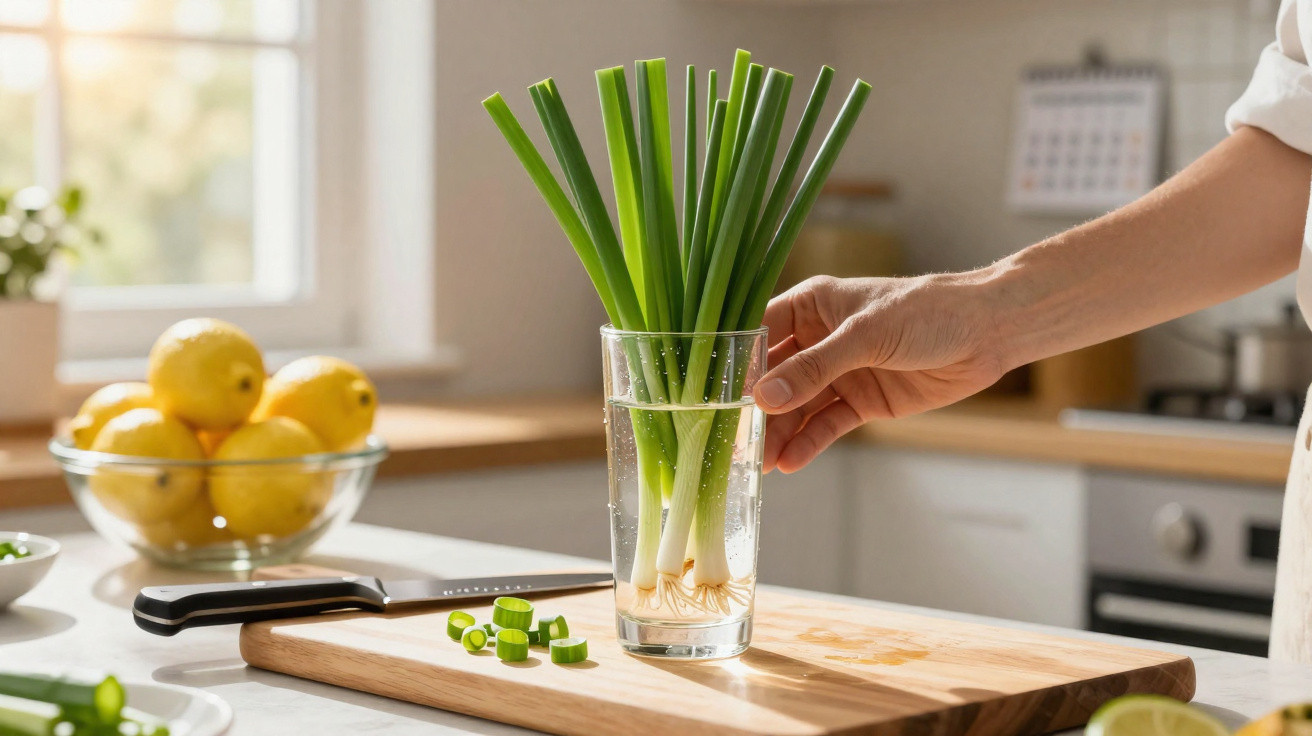
The bunch of spring onions looked flawless when you picked it up at the market: firm green stalks, white bulbs glistening with moisture and roots still carrying a little soil.
Forty-eight hours later, they are floppy, leaking water into the fridge drawer and carrying the faint smell of regret. But some people insist that theirs remain crisp for almost three weeks - simply by keeping them in a glass of water.
You may have seen the short video: a tall glass holding a cluster of spring onions upright like flowers, with their roots sitting in clear water. Three weeks on, the before-and-after image seems implausible. The same onions, in the same glass, are still vivid and fresh. No slime or yellow pulp - just crisp greens ready to add to an omelette.
It seems like a minor kitchen tip, perhaps too minor to make much difference. Yet it can alter how you view your fridge, food waste and even your shopping routine. There is some quiet science at work in that glass.
Why spring onions stay alive in a glass of water
Placing spring onions upright in a tall glass of water is not conventional storage. In effect, you are keeping them alive. The pale roots at the base are not useless remnants; they are small pumps that can still draw water upwards through the hollow green stalks.
When left flat in a plastic bag, the onions lose moisture through their cut ends and outer layers. Stand them upright with their roots drinking, however, and they act more like a potted plant. Rather than gradually turning into a limp, rubbery disappointment, they remain full and firm. Your fridge becomes a sort of slow-motion windowsill garden.
That is the essential distinction: a fridge drawer means “storage until decay”, while a glass of water provides “mini hydroponic life support”. Seen this way, the claim of three weeks of freshness no longer sounds magical. It makes sense.
Talk to home cooks and you are likely to hear a very similar account. “I used to throw away half the bunch,” they’ll say, “now my onions last so long I forget when I bought them.” A 2024 survey by a UK food-waste charity estimated that households throw away millions of bunches of spring onions each year, often after only five or six days in the fridge.
Then social media did what it does. Viral reels and short clips began showing bunches displayed in tall glasses like miniature green bouquets. Some users reported fresh onions after 10 days, while others managed 18 or even 21 days by changing the water only a couple of times. The real surprise was not merely how long they lasted, but that they regrew: trim the tops and fresh green shoots emerge again.
A woman in Berlin tracked the process as though it were a scientific study. During the first week, she cut the greens three times for soups and stir-fries. In week two, the regrowth was finer but still useful. By day 19, the white sections still snapped cleanly. Her original €2 bunch had supplied five meals, without a single limp strand ending up in the bin.
The explanation for this modest miracle is basic plant biology. Spring onions are alliums built to carry on growing for as long as possible. Provided the basal plate and roots stay intact and damp, water and nutrients continue moving up the stalk. That process stops when the roots dry out, become starved of air or begin rotting in stale moisture.
Plastic bags hold humidity and bacteria directly against the plant tissue, creating the conditions in which slime and mould develop. In a tall glass, the roots remain in clean water while the stalks are exposed to air. The plant can breathe. Oxygen in the water helps postpone root rot, while the fridge's low temperature slows respiration and decomposition.
The result is the best of both conditions: water continues to be absorbed from below, while gentle cold surrounds the plant. The onion is not merely “staying fresh”; it continues operating as a living system, almost as though it had never been lifted from the soil.
How to store spring onions in water for up to three weeks
The technique looks almost absurdly easy, perhaps explaining why so many people overlook it. Choose a tall glass or jar that is unlikely to topple, then add 2.5–5 cm of cold water. Untie the spring onions, remove any soft root ends and position them upright, with the roots submerged but most of the white bulbs above the waterline.
Put the glass in the fridge door or on a shelf where it is safe from being knocked over. That is your new spring onion station. Every few days, discard the water, rinse the glass and top it up with fresh cold water. There are no specialist tools or complicated preparation steps - only a small routine that gradually pays off.
Whenever you need some, cut the green tops using scissors or a knife, leaving the lower white section and roots in the glass. They will carry on drinking, remain upright and often produce new shoots. It feels less like using something in storage and more like gathering a tiny indoor crop.
Of course, this is where everyday life intervenes. People enjoy a useful hack, then forget about it a week later. You may decide not to change the water “just this once”, leave the glass in a dark corner or squeeze it beside an open jar of pickles. The onions may survive, but they will not flourish. Let’s be honest: nobody really does this every day.
Think of the glass as a houseplant that needs very little attention. Refresh the water twice weekly rather than worrying over it daily. If the roots become brown and stringy, trim them gently before adding clean water. If the tops start to droop, shift the jar to a slightly colder shelf.
A frequent error is filling the glass too high, so that the white bulbs are underwater. This allows rot to develop from the base. Only the roots and very bottom should be immersed. Another mistake is wrapping the tops in cling film “to keep smells in”. Doing so traps moisture and starves the plant tissue of air. Let them breathe: they are onions, not leftovers.
One food scientist I spoke to put it in a way that stuck with me:
“When you store spring onions in water, you’re not extending shelf life, you’re extending plant life. Your fridge becomes less of a morgue and more of a slow-motion garden.”
That shift in perspective affects how you treat the unassuming glass in the corner. You may even label it for a partner or children: “ONION GARDEN – DO NOT SPILL”. It sounds silly until you’ve cleaned scallion water from the bottom of a fridge door.
A few practical details will help you get the most from this method:
- Pick a narrow, sturdy glass or jar that keeps the onions upright and stops them falling out.
- Keep the water shallow: cover the roots, not the white sections.
- Replace the water every 3–4 days to prevent odours and bacterial build-up.
- Remove yellowing leaves promptly so that decay cannot spread.
- Keep the glass somewhere visible, so you remember to use the onions and refresh the water.
When done properly, the glass becomes as ordinary a feature of the kitchen as the salt pot beside the hob.
What this small spring onion trick changes in your kitchen
There is something subtly defiant about making a 50-cent ingredient last for almost three weeks. You begin approaching meals differently. Rather than purchasing spring onions for one particular recipe, you keep them ready for use, confident they will still be there 10 days later when a sudden fried-rice craving strikes.
Texture tells the truth. Take a bite from a spring onion that has spent two weeks in water and it can still deliver that clean snap and fresh grassy scent. There are no sad pale-yellow leaves or soggy ends to cut away and discard. On a hectic weeknight, that sort of reliability is strangely comforting: you open the fridge to find something green that has not given up on you.
At a deeper level, a tall glass of onions on the fridge shelf offers a small answer to food-waste fatigue. In a world where we quietly discard a third of the food we grow, one long-lasting bunch of spring onions will not save the planet. But it can change the story you tell yourself while cooking: that you can use what you buy, and that you are not destined to repeat the same cycle of wilting and guilt. That little glass of water is doing more than it appears to do.
| Key point | Detail | Benefit for the reader |
|---|---|---|
| Keeping the roots alive | Roots immersed in water continue drawing up moisture | Fresh, crisp spring onions for almost three weeks |
| Changing the water regularly | Clean water twice a week limits bacteria and odours | Less risk of rot and better flavour |
| Cutting only the green stalks | Leave the bulb and roots in place to encourage regrowth | Several harvests from one bunch |

















Comments
No comments yet. Be the first to comment!
Leave a Comment