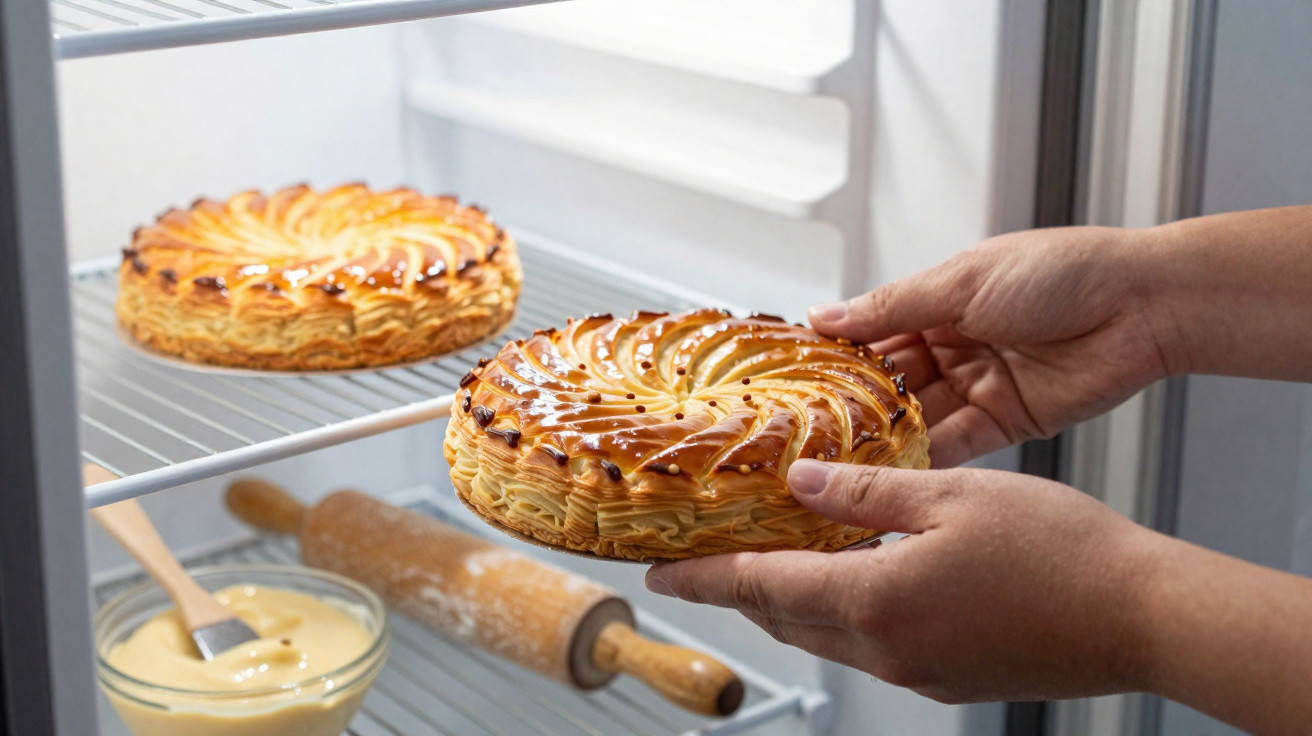
Every January, it is the same disappointment: the galette looks spectacular in the oven – then, when sliced, it falls apart into puff pastry and leaked cream.
Anyone baking a Galette des Rois at home often puts real care into it: quality butter, fine puff pastry and lovingly mixed almond cream. Then, just before the ceremonial slice, comes the shock: the edges have burst open and the filling is stuck, burnt, to the baking tray. Many home bakers blame “poor pastry” or “the wrong baking time”. In fact, the cause is usually a far simpler mistake – one that can be avoided with a single step.
Why the Galette des Rois bursts and leaks in the oven
The usual scenario is this: the galette rises dramatically in the oven, becomes unevenly thick, bulges in places and then splits at the side. The almond cream pushes out through that opening and spills onto the baking tray. The result is soggy edges, burnt filling and uneven pastry.
The problem starts much earlier, while rolling out and assembling the puff pastry. When pastry is handled extensively, its gluten network becomes tight. This provides elasticity, but in the oven it also makes the pastry want to shrink back.
If the galette goes into the oven immediately after shaping, this is what happens:
- The pastry contracts as it bakes, pulling at the sealed edges.
- The joins between the two pastry rounds weaken and split.
- The filling finds every tiny gap and leaks out through it.
- If the cream has been whipped too full of air or spread too close to the edge, it puts even more pressure on the pastry border.
Many people then look to the oven temperature or the recipe for the answer. In reality, one small but essential stage is missing – and it determines whether the galette stays intact or “explodes” in the oven.
The overlooked step: chilling in the fridge
The best defence against open edges comes from chilling, rather than baking. A Galette des Rois should never go into the oven straight after it has been assembled. First, it needs a proper rest in the fridge.
The game changer: at least two hours in the cold, or ideally a full night, before the galette goes into the oven.
Once the two pastry discs are layered together, the cream has been added and the edges sealed, the real secret begins: resting time. Put the fully assembled, unbaked galette in the fridge – not merely for a few minutes, but for at least two hours. If you can plan ahead, make it the evening before, loosely wrap it in cling film and bake it the following day.
This time in the fridge has several benefits:
- The gluten network relaxes, so the pastry loses its excessive tension.
- The edges become more stable and adhere more effectively.
- The almond cream firms up and no longer presses as hard against the pastry wall.
- The puff pastry rises more evenly and is less likely to distort.
On baking day, simply leave the chilled galette at room temperature for 10 to 15 minutes, brush it once more with egg, score the classic pattern across the surface and bake at around 180°C for roughly 40 to 45 minutes. This gives it colour without burning the base.
How to make a tightly sealed, neat Galette des Rois step by step
Chilling only works properly when the assembly is right as well. Small shaping details can decide whether the filling stays obediently inside later on.
Prepare the pastry and secure the base
The lower pastry round forms the foundation. It should not be rolled too thinly, otherwise the weight of the filling can make it soft and more prone to tearing. Prick it a few times with a fork – but only lightly, so you do not create holes through which the cream can escape. This lets air bubbles out without causing the base to burst.
Apply the filling correctly
Spread the almond cream over the pastry from the centre outwards. Leaving a clear border is vital: around two centimetres from the edge is a useful guide. Spreading it right to the edge is practically inviting disaster.
There is another important point: the filling should be thick and creamy rather than heavily aerated. Too much air inside expands in the oven and forces the pastry layers apart.
Seal the edges properly
Before placing the upper pastry disc on top, lightly moisten the exposed edge of the lower round with water. Do not use too much; a thin film applied with a finger or brush is enough. Place the top disc over it, press from the centre outwards with your fingertips, then carefully seal the entire edge.
An important rule of thumb: press with your fingers, not by crushing with a fork – otherwise you stop the puff pastry from rising.
Pressing the edge shut with a fork compresses the layers in the pastry structure. Although it may look like a firm seal, it prevents the pastry from puffing up attractively and may encourage cracks elsewhere.
Let steam escape
A galette needs small vents so steam can escape. A little hole in the centre works as a “chimney opening”. You can also make a few tiny slashes in the surface with the tip of a knife. They remain discreet in appearance, yet help prevent the pastry from bursting in random places.
Pre-baking checklist: keeping everything inside
Before sliding the baking tray into the oven, take a quick moment to check the following points:
- The galette has rested in the fridge for at least two hours, preferably overnight.
- The filling stops around two centimetres before the edge, without forming a thick ridge.
- The edges are clean and firmly pressed together with fingertips, with no egg wash on the cut edge.
- The lower pastry round has been lightly pricked without being pierced through.
- A small opening in the centre and several tiny pricks allow steam to escape.
- The oven is preheated to around 180°C, with a baking time of roughly 40 to 45 minutes, while keeping an eye on the base turning golden brown.
What really happens to puff pastry and almond cream
Understanding how puff pastry behaves in the oven helps avoid many mishaps. The pastry consists of multiple layers, alternating between dough and butter. In the hot oven, the butter melts, water trapped in both the butter and dough turns to steam, and the resulting air pressure lifts the layers – creating the characteristic flaky effect.
If the pastry is under too much tension or creased at the edges, that pressure will seek the easiest way out. This may be a thin patch at the edge, a small tear or an area that has not been sealed properly. That is exactly where the galette then splits open.
The almond cream behaves rather like a semi-solid dough: it first softens, then begins to set slightly in the oven. Until then, it remains very mobile. If it is too close to the edge or contains too much air, it pushes against the pastry border as it rises. When the edge gives way, the filling slips out and ends up as a brown crust on the baking tray.
Practical variations and extra tips
The same principles apply if you make the galette with other fillings – such as pistachio, chocolate or apple. With particularly wet fillings, including apple compote, it is worth leaving an even wider border and extending the chilling time so that the pastry has enough time to firm up.
For larger gatherings, such as family celebrations, consider baking several smaller galettes rather than one enormous one. Smaller diameters place less strain on the edges and often bake more evenly. The fridge rest remains just as essential, of course.
If you are using only ready-made chilled puff pastry, follow the same method: cut out the pastry rounds, place the filling in the centre and allow time for chilling. Even inexpensive ready-made pastry behaves far better when it has rested long enough before baking.
Leftover slices can be reheated without difficulty. For the best results, warm them for a few minutes in the oven at a moderate temperature or in an air fryer. This keeps the pastry crisp without drying out the filling. Puff pastry heated directly in the microwave, by contrast, tends to become soft and chewy.

















Comments
No comments yet. Be the first to comment!
Leave a Comment