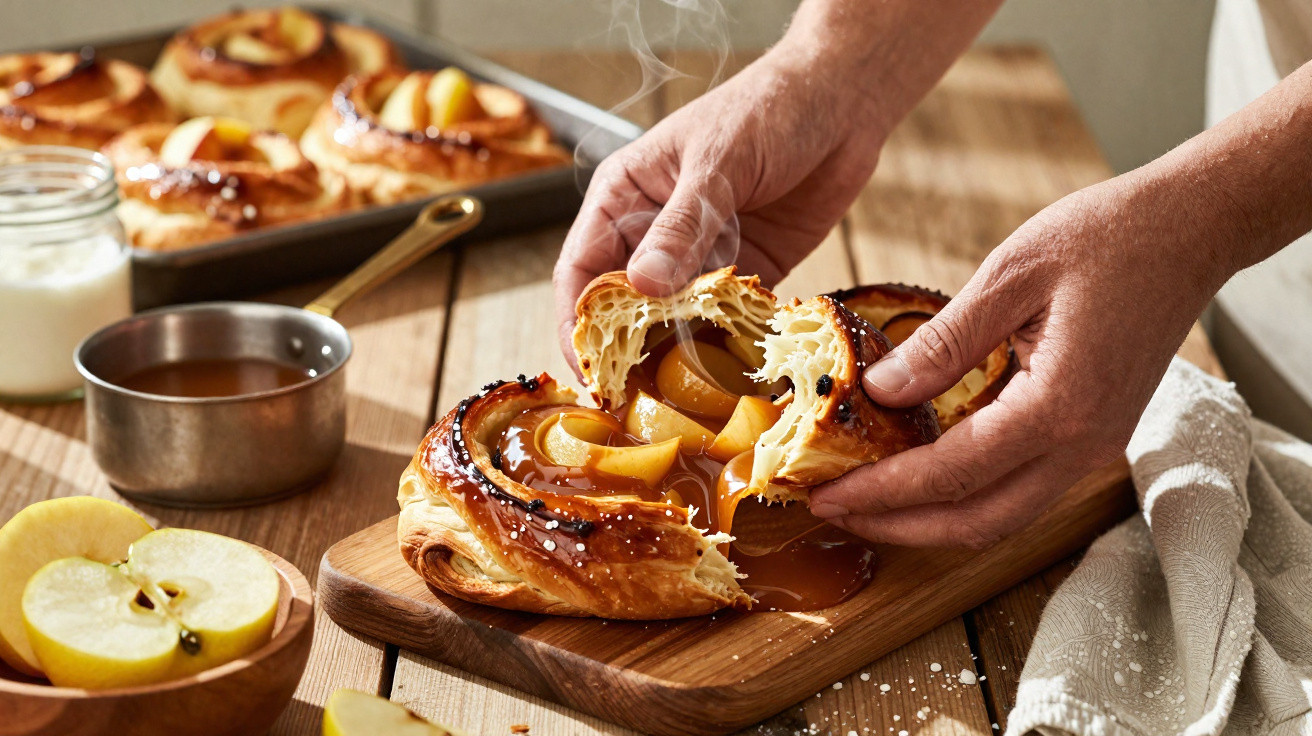
A tender yeasted dough, fragrant apples and melting caramel – and suddenly your own kitchen table feels like the counter of a good bakery.
Pull apart a slice of still-warm brioche and you first hear the soft tear of the crumb, then catch the scent of buttery dough and caramelised apples. That is precisely the experience this version aims to recreate: an Apple Caramel Brioche that comes remarkably close to artisan-bakery quality with straightforward ingredients, while remaining surprisingly practical for everyday baking.
Why this Apple Brioche has so many fans
The pairing is uncomplicated yet effective: an airy yeasted dough meets sweet, gently tart apples and a fine coating of butter caramel. The result works for Sunday breakfast, afternoon coffee or even an impromptu dessert.
The combination of soft brioche and lightly tart, caramelised apples feels as comforting as childhood – but a little more sophisticated.
Many bakeries return these kinds of brioches to their displays in spring and autumn, when fruit-filled pastries come back into season. At home, the advantage is that you decide exactly how fruity, caramel-rich and buttery it should be.
The foundation: a soft, rich brioche
Ingredients for the dough
For a brioche baked in a loaf tin or shaped into a wreath, this classic quantity is enough:
- 300 g wheat flour (ideally Type 550)
- 3 eggs (medium)
- 150 g softened butter
- 10 g fresh yeast
- 40 g sugar
- 5 g salt
This balance creates a dough rich enough for a delicate crumb, without becoming so heavy that it struggles to rise. Those who prefer an even more indulgent result can increase the butter slightly, but should allow the yeast a little extra time.
Ingredients for the caramelised apples
- 3–4 apples (for example, Golden or Boskoop)
- 40 g butter
- 50 g brown sugar
The apples contribute both flavour and moisture, so choosing the right variety is worthwhile.
Step by step to bakery-style texture
Knead the dough until it is truly elastic
Put the flour into a bowl and make a well in the centre. Crumble in the yeast, then add the sugar and eggs. Working from the middle outwards with your fingers, combine everything until a dough begins to form. Only then knead in the salt.
Now comes the stage many home bakers find challenging: sustained kneading. The dough needs around 15 minutes to become smooth and elastic. It should pull slightly away from the sides of the bowl and have a glossy finish.
The longer and more evenly the dough is kneaded, the finer and lighter the crumb will be later.
Incorporate the softened butter in several additions. After each piece, knead thoroughly again until it has been fully absorbed. Finally, shape the dough into a ball, place it in a lightly oiled bowl and cover it. Leave it to rise for at least two hours, until doubled in volume.
Caramelise the apples without turning them to purée
While the dough is resting, peel the apples and cut them into thin, evenly sized wedges where possible. Melt the butter in a frying pan, add the apple pieces and brown sugar, and cook gently over a medium heat for around eight minutes.
The apples need to soften while still holding their shape. Stirring too vigorously or cooking at too high a heat can quickly turn them into apple purée. Once the pieces are lightly browned and glossy, transfer them to kitchen paper and let them cool briefly so any excess syrup can drain away.
Shape the brioche and prove it once more
Fill and roll the dough
Briefly knock back the risen dough with your fist. On a lightly floured surface, roll it into a rectangle measuring approximately 30 x 20 centimetres. Spread the caramelised apples evenly over it, then carefully distribute any released caramel.
The more evenly the filling is spread, the more reliably every slice will contain a good share of apple and caramel.
Roll up the dough from the long side. If you wish, cut the roll lengthways in half and loosely twist the two strands into a plait-like shape. Alternatively, form the roll into a wreath and place it on a baking tray.
Set the brioche on a tray lined with baking parchment and leave it to prove again for about one hour, until visibly risen and light in appearance.
Bake until it reaches the right shade of golden brown
Preheat the oven to 170 °C conventional heat. Depending on its shape, bake the brioche for around 25 minutes, until the surface is golden brown and springs back lightly when pressed with a finger.
After baking, allow it to rest for a few minutes so the crumb can set. Cutting it while it is too hot forces much of the air back out of the dough.
Tips for a successful Apple Caramel Brioche
The best apples to use
Not every variety behaves the same way in the oven. Here is a quick guide:
| Variety | Characteristic | Effect in the brioche |
|---|---|---|
| Golden | fairly sweet, stays relatively firm | balanced sweetness, distinct pieces |
| Boskoop | noticeably tart, aromatic | strong contrast to the caramel |
| Gala / Elstar | mild, medium firmness | gentle fruit flavour, light juiciness |
Very soft apples quickly lose their shape and release a great deal of liquid. This can leave the inside of the brioche dense and heavy.
Judging heat and baking time correctly
- If your oven runs hot, reduce the temperature slightly and bake for a few minutes longer.
- If your oven is weak, keep it at 170 °C and extend the baking time instead.
- Should the surface colour too quickly, cover the brioche loosely with aluminium foil.
The brioche should bake through gradually, allowing the dough time to rise calmly while the apples soften inside.
Keeping the dough light and moist
The most important factor is patience with the proving times. Trying to ‘push’ the yeast with too much heat risks a flat flavour and an uneven texture. Room temperature is entirely sufficient. When in doubt, wait 20 minutes longer rather than putting the dough into the oven too soon.
Serving, storing and reviving it
How Apple Brioche tastes best
It is most popular served slightly warm and plain, perhaps alongside an espresso or a mug of cocoa. Many people cut generous slices and spread them, quite traditionally, with butter. A spoonful of whipped cream or some chilled crème fraîche also works very well, as its gentle acidity balances the caramel.
Making clever use of leftovers
Stored in an airtight container, the brioche stays moist for two to three days. The oven is better than the microwave for reheating: wrap it in aluminium foil and warm at 160 °C for a few minutes.
- Slightly stale slices can be fried in butter in a pan.
- Leftover pieces can become a luxurious bread pudding with vanilla sauce.
- Cut into cubes, the brioche makes a base for a dessert glass with yoghurt and fresh fruit.
What home bakers can learn from this recipe
Core principles for better yeasted doughs
Anyone willing to embrace the slightly longer preparation will benefit in other recipes too. Extended kneading and sufficient proving time improve almost every yeasted dough, from cinnamon rolls to raisin plait. The order in which ingredients are added, the gradual incorporation of butter and a respectful approach to yeast are all key variables.
Variations for every season
This recipe provides an easy base for adaptations. Apricots or peaches suit summer, while pears are ideal in late autumn. For a nuttier version, scatter chopped hazelnuts or almonds over the filling. A touch of cinnamon, cardamom or tonka bean noticeably changes its character without undermining the central idea.
For families with children, making a second, smaller shape is worthwhile: fill one portion of the dough traditionally with apples and the other with chocolate chips. In this way, two tastes share the same basic brioche – and what may seem like an elaborate baking day becomes an easy, fragrant afternoon in your own kitchen.

















Comments
No comments yet. Be the first to comment!
Leave a Comment