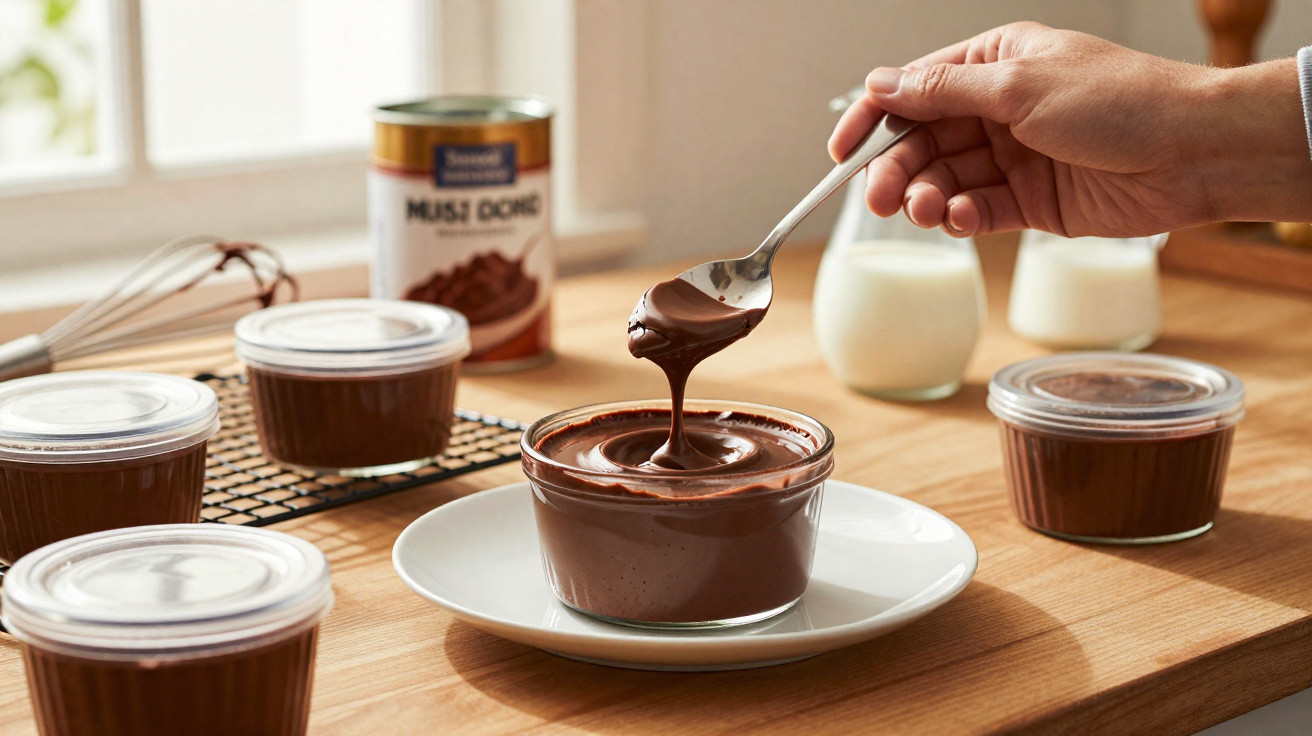
The saucepan was already on the hob when doubt crept in. Double cream, whole milk, sugar: the familiar line-up looked back at me as both a promise and a warning. I wanted a chocolate pudding that was luxurious-the sort you eat slowly, spoonful by spoonful-not the dense, sleep-inducing version that stays in your stomach all evening.
As steam drifted up and the kitchen lightly misted over, I remembered every “famous” dessert I had regretted after three mouthfuls. Too rich, too sweet, too much. What I wanted was something that tasted of childhood yet belonged in an adult evening: somewhere between comfort food and a small gesture of self-care.
There is a sweet spot between light and rich.
You find it by considering what you leave out of the saucepan.
The secret to chocolate pudding that feels silky, not sleepy
The first mistake people make with chocolate pudding is assuming it needs masses of cream to feel indulgent. You can still get that deeply chocolatey spoonful without making an entire bowl feel like a brick. The answer is texture rather than fat.
Picture a pudding that gives the slightest wobble when the dish is shaken, then melts softly across your tongue. It covers the palate without clinging like a heavy custard. That texture comes down to balance: cornflour for lightness, egg yolks for silkiness, and good cocoa for an intense flavour without unnecessary bulk.
There is no need for a professional kitchen to get it right. A whisk, a little patience and the confidence to stop just before it becomes “too thick” are enough.
I discovered this the difficult way one rainy Tuesday, when the only person I was trying to impress was myself. It had been a long, chaotic day-the sort when toast becomes dinner and emails take over. Making dessert felt like a stubborn little act of resistance.
I opened three recipes, blended them together and used far too much cream. Once chilled, the pudding looked flawless: glossy, dark and pretty enough for a film. The first spoonful was powerful. The second felt… heavy. By the third, I was already craving tea and a walk. Half-eaten, the bowl returned to the fridge, where it sat like a guilty secret.
The following week, I had another go. I used less cream, more milk, another spoonful of cocoa and a pinch of salt. The surface was just as glossy, but it felt entirely different to eat.
There was no magic behind the change. It was simply about proportion and attention. Fat adds luxury, but too much of it dulls both flavour and appetite. Cornflour thickens without adding weight, producing that gentle wobble you can almost taste before the spoon reaches your lips.
Egg yolks bring richness and a velvety finish, but they do not need a supporting cast of extra butter and whipped cream to feel celebratory. High-quality chocolate or cocoa-ideally both-delivers the flavour, allowing you to use less sugar while still feeling properly treated.
The principle is straightforward: make chocolate the star, and let every other ingredient support it rather than steal the scene.
The classic chocolate pudding recipe that doesn’t knock you out
This is the reliably effective method. With a medium saucepan still off the heat, whisk together 35 g unsweetened cocoa powder, 67 g sugar, 24 g cornflour and a pinch of fine salt. This dry mixture is your safeguard against lumps later on.
Gradually whisk in 600 ml milk-whole or semi-skimmed both work-until it resembles chocolate milk with no visible streaks of powder. Put the saucepan over a medium heat and continue whisking gently. At first, it will appear as though nothing is changing; then the mixture will suddenly start to thicken and bubble.
Allow it to bubble for 30–60 seconds so the starchy taste cooks away, then remove it from the heat. Whisk through 1 teaspoon vanilla and 60–80 g chopped dark chocolate until it has melted into a glossy finish. That is all: no fuss and no mountain of cream.
This is often the point at which things go wrong. The pudding thickens, you worry, and cook it longer “just to be safe.” Or you step away for twelve seconds and it catches on the pan. Or you add every luxurious ingredient in the cupboard because you are pursuing restaurant-style decadence.
Here is the reassuring truth: pudding continues to thicken as it cools. If it resembles thick hot chocolate while it is on the hob, it is exactly where it should be. If it resembles wet cement, you have taken it too far. And loading it with cream and butter will not repair a grainy texture; it only makes that grainy texture… heavier.
Let’s be honest: no one really makes this every single day. When you do make it, it is better to get it right first time than attempt a last-minute “fix” with patchwork additions.
The most reassuring moment is when you pour the warm pudding into little glasses and it settles in a slow, glossy wave. That’s when you know you’ve hit that sweet spot between cozy and overkill.
Choose the right chocolate
Go for dark chocolate containing 60–70% cocoa. Anything below this will make the pudding overly sweet, while anything above it may taste harsh and dry in a milk-based pudding.Avoid an overload of full-fat cream
Replace some of the cream with milk, or use milk alone if your chocolate is good quality. Your tongue notices flavour, not the fat percentage listed on the carton.Whisk with purpose
Whisk before applying heat, then keep whisking gently as it cooks. This prevents lumps and creates that smooth, nearly professional finish.Chill it, but not for too long
Two to three hours in the fridge is ideal. It will set more firmly overnight, which some people prefer, but the texture is at its dreamiest on the same evening.Keep the finish light
Rather than piling on huge swirls of whipped cream, add a small spoonful, a few cacao nibs or some shaved chocolate. You still get the visual drama without extra heaviness.
Why this chocolate pudding feels different to eat
There is a gentle pleasure in a dessert that does not leave you needing to recover afterwards. Eat a small pot of this chocolate pudding and you feel comforted rather than slowed down. The richness arrives immediately-the first spoonful delivers chocolate, warmth and nostalgia-then it clears cleanly, without a lingering coating of fat.
Partly, this is physical. Lighter dairy gives your body less work to do when digesting it, particularly in the evening. It is also psychological: you do not leave the table wondering, “Why did I do that to myself?” Instead, there is the quiet glow of having treated yourself with kindness.
It changes how you serve dessert, too. Once a pudding is no longer a bomb, it suits far more occasions: tired weeknight dinners, Sunday lunches after a roast and potatoes, or calm evenings when you want something caring without turning it into a feast.
Serve it in espresso cups for small shots of chocolate, or spoon it into lidded jam jars for effortless fridge desserts. It waits until you are ready for it, rather than the other way around. There is no urgency to “finish the big thing” before it spoils or leaves you feeling worse.
This style of pudding invites conversation, too. People ask, “What did you put in this?” because it tastes rich without knocking them out. You can explain that you swapped extra cream for better chocolate, that the cornflour does the heavy lifting, and that a pinch of salt discreetly sharpens every flavour.
You begin to see that “light” need not mean diet food, while “rich” does not have to mean excess. It simply means considered. It means choosing flavour over volume and sensation over spectacle. Once you have tasted that balance, it is difficult to return to desserts that impress the eye but argue with the body.
A small ritual that is easy to share
Next time you are tempted to bake a cake or order something elaborate, remember this instead: a saucepan, a whisk and ten calm minutes at the hob. No roaring mixer, no oven warming the entire flat, and no lengthy list of steps. Just you, stirring and watching the mixture move from thin and uncertain to thick and full of promise.
That transformation has something grounding about it. Dessert becomes less of an “event” and more of a modest ritual-something you can repeat without arranging your day around it. Double the recipe for friends or keep it small for a quiet evening; either way, it fits real life rather than only special occasions.
If you have ever pushed a dessert plate away halfway through, you know the pull between pleasure and regret. This pudding sits on the other side of that divide. It gives you flavour, texture and a small pause in the evening, then allows you to carry on with your night.
You can experiment with it as well: replace a little of the milk with coffee, finely grate in orange zest, or add a touch of cinnamon or chilli. The base remains unchanged, light enough to accommodate whichever twist you fancy trying. It is a recipe that can evolve with you rather than locking you into a single “perfect” version.
You may find yourself sharing it with others: the friend who loves chocolate but dislikes feeling overly full; the parent wanting an easy dessert that is not simply another cake; or the teenager learning to cook who needs a success that looks impressive without requiring technical acrobatics.
One saucepan, a small handful of ingredients and another way to think about “rich”: not something heavy and showy, but something to enjoy completely, spoonful after spoonful, without having to lie down afterwards. That is the sort of recipe that quietly earns a lasting place in your life.
| Key point | Detail | Value for the reader |
|---|---|---|
| Balanced texture | Cornflour + egg yolks, cooked briefly, then cooled | Silky pudding that feels indulgent without being dense |
| Flavour over fat | Good cocoa and dark chocolate, less cream, moderate sugar | Deep chocolate taste with no “food coma” effect |
| Simple method | One saucepan, whisking from cold to thick, short chill time | Accessible dessert that fits into busy evenings and everyday life |

















Comments
No comments yet. Be the first to comment!
Leave a Comment