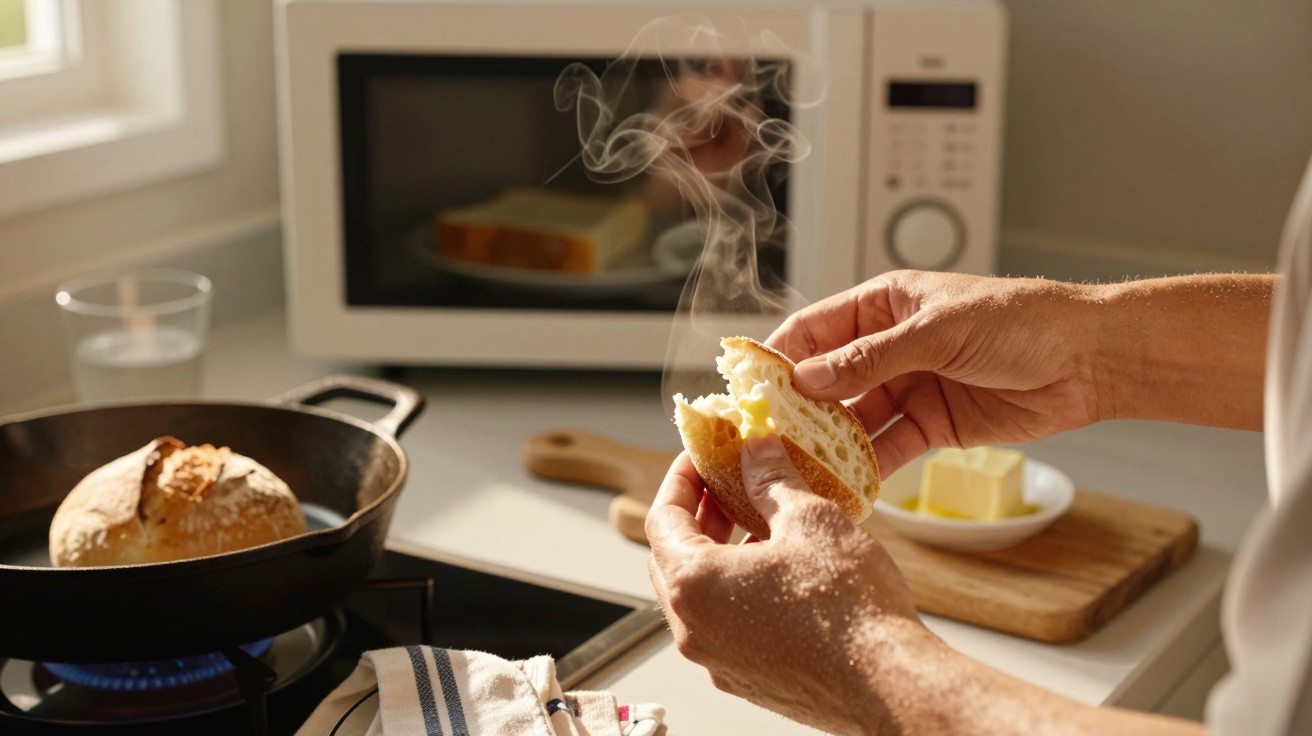
It has the scent of an early morning bakery: butter, coffee and quiet conversation. You pull off a piece and it is soft, springy, with the crumb yielding beneath your fingertips. Exactly right.
Then life gets in the way of breakfast. Two minutes later, you return to the kitchen and find the bread has gone cold. No problem: into the microwave it goes for 20 seconds, accompanied by that familiar hum. You come back to a hot slice, but not the same one. It is firmer, oddly chewy and almost rubbery around the edges.
You take a disappointed bite and wonder how a machine that can heat soup so effortlessly can spoil something as straightforward as bread. The explanation lies in invisible motion: a water-and-gluten choreography you cannot watch, though your jaw certainly notices it.
Why your microwave turns soft bread into a rubbery disappointment
The key point is that microwaves heat food differently from an oven or frying pan. They cause the water molecules inside bread to move rapidly, producing heat from within. This is why a slice becomes hot in seconds: the crumb is heating itself, rather than the crust gradually warming the interior.
Fresh bread contains plenty of water, held quietly within its gluten structure. In a microwave, those water molecules are stimulated so suddenly that much of the moisture escapes as steam. The remaining bread dries very quickly. It has not truly been “cooked again”; rather, it has been depleted. Its light, resilient crumb begins to resemble a sponge left out in the sun.
Meanwhile, gluten - the protein network responsible for bread’s structure - contracts. Heat causes those protein strands to tighten. Without enough water to keep them relaxed, they become rigid and create a sort of edible elastic. That is why a loaf that felt airy ten minutes earlier can suddenly seem like exercise for your teeth.
Bakeries deal with this all the time. Staff quickly refresh day-old rolls in an oven rather than a microwave because they understand the outcome. At home, however, convenience usually prevails. You return from the bakery or supermarket, cut into a lovely loaf and, once it has cooled, put it in the microwave “just for a few seconds”.
Food scientists have quantified what your jaw already detects. Texture testing shows that bread reheated in a microwave becomes noticeably harder within minutes, whereas oven-warmed bread remains much nearer to its initial softness. Flour and yeast are not responsible for the contrast; the difference comes down to how water responds to microwave energy.
Imagine the water molecules as people at a concert. In an oven, they sway, shift and distribute warmth gradually. In a microwave, it is more like a mosh pit: they collide with such force that many escape as steam. This swift loss of moisture leaves the starch and gluten in the crumb without their cushioning. Without that cushion, there is resistance.
Another, less obvious culprit is starch retrogradation. As bread cools after baking, its starch molecules slowly rearrange and firm up, which is what we experience as staling. Microwaving can reverse part of this temporarily, explaining why bread seems soft as soon as it comes out. But once it cools again, the starch recrystallises more quickly, making the crumb tougher than it was before. It is a boomerang effect concealed behind that seemingly harmless 20-second button.
How to warm bread without wrecking its soul
The best approach is to use an oven or hot frying pan rather than a microwave, even when you are short of time. It may sound inconvenient, but it need not be. Heat the oven to 160–180°C, lightly sprinkle or brush the crust with water, then place the bread directly on the rack for 5 to 8 minutes. The exterior will become crisp, the centre will warm gently, and the gluten will loosen instead of tightening.
For individual slices, a dry frying pan is remarkably effective. Put the bread into a preheated pan over a medium heat, cover it for 1 minute, then remove the lid for 1 to 2 minutes. The underside toasts lightly, the crumb becomes softer and the bread retains a tender chew without veering into rubberiness. It is a small ritual that can make even a two-day-old baguette taste lively again.
If a microwave genuinely is the only available option, you can reduce the harm. Loosely wrap the bread in a slightly damp, rather than wet, paper towel, select the lowest power setting and heat it in 5- to 8-second bursts. Stop as soon as it is warm rather than hot. The aim is to gently encourage the water molecules, not make them race out of the loaf.
On an exhausting weekday, most people simply put bread on a plate and heat it at full power. Let’s be honest: nobody really takes laboratory-level precautions every single day. You get home late, feel hungry, and the microwave seems like the only friend you have. There is no judgement in that. The answer is to alter one or two small habits, not to become a bread monk.
A frequent mistake is reheating bread directly from the fridge. Chilled bread has already forced water away from its starch and gluten, accelerating the staling process. If you then shock it in the microwave, moisture escapes aggressively and even less remains. Allow bread to return closer to room temperature before reheating it, or freeze it instead of refrigerating it in the first place.
It is also tempting to “save time” by heating several slices in a stack. This generally creates uneven results: soft at the centre and rubbery around the edges. Reheat one or two slices at once, and accept that an extra 30 seconds may save your breakfast altogether. On a difficult day, that matters.
We have all experienced the moment when a perfect loaf becomes a peculiar chewy pad beneath the stark light of a microwave. Every kitchen has known this small betrayal. One morning, beside a rack of golden baguettes, a Parisian pastry chef put it bluntly:
“Bread is alive, even after it leaves the oven. When you throw it in the microwave, you’re not just heating it. You’re shocking it.”
A few simple principles will help keep bread closer to its lively, just-baked character:
- Choose oven or frying-pan reheating for anything genuinely fresh or artisan-made.
- If you have to use a microwave, choose low power, very short bursts and a damp towel.
- Freeze bread rather than refrigerating it, then reheat it gently from frozen.
These are not rules that must be followed perfectly every time. They are small adjustments to use when you care about the slice in front of you. On an ordinary Tuesday, that quiet choice can turn a hurried snack into a small moment of comfort.
What tough bread in the microwave really tells us about our food
Once you understand what happens inside a slice, it is difficult not to notice the same pattern elsewhere. Pizza crust becomes hard around the edges. Croissants lose their flaky layers. Even tortillas can shift from pliable to stiff in almost no time. Each is acting out the same water-and-gluten drama under abrupt pressure.
There is something almost personal about knowing this. The microwave is not “bad”; it is simply ruthlessly efficient when it comes to water. Fresh bread is soft not through magic, but because moisture exists in a delicate balance with gluten and starch. Disturb that balance too quickly, and the bread responds with resistance. Your teeth simply happen to be in the way.
The next time you reach for the microwave door, you may pause for half a second. You might still choose the 20-second blast, because life is busy and you are hungry. Or you might put the bread in the oven and wait those few additional minutes. Either way, you will understand why the decision matters in a very physical, very edible sense.
And that understanding tends to spread. Someone asks, “Why is this bread so tough?” and you may find yourself explaining water molecules, gluten and tiny unseen dancing crowds. A humble slice becomes a story to pass on: a small piece of science woven into the everyday ritual of tearing, buttering and eating bread while it is still warm enough to feel like a small kindness.
| Key point | Detail | Why it matters to the reader |
|---|---|---|
| Microwave vs oven | Microwaves agitate water molecules forcefully, while ovens heat more slowly and evenly | Understand why texture changes and select the right reheating method |
| Water and gluten | Rapid evaporation leaves gluten and starch short of moisture, producing a tough crumb | Know what makes bread rubbery and how to prevent it |
| Practical fixes | Low-power bursts, a damp towel, or brief oven or pan reheating | Simple ways to keep bread soft and pleasant to chew |

















Comments
No comments yet. Be the first to comment!
Leave a Comment