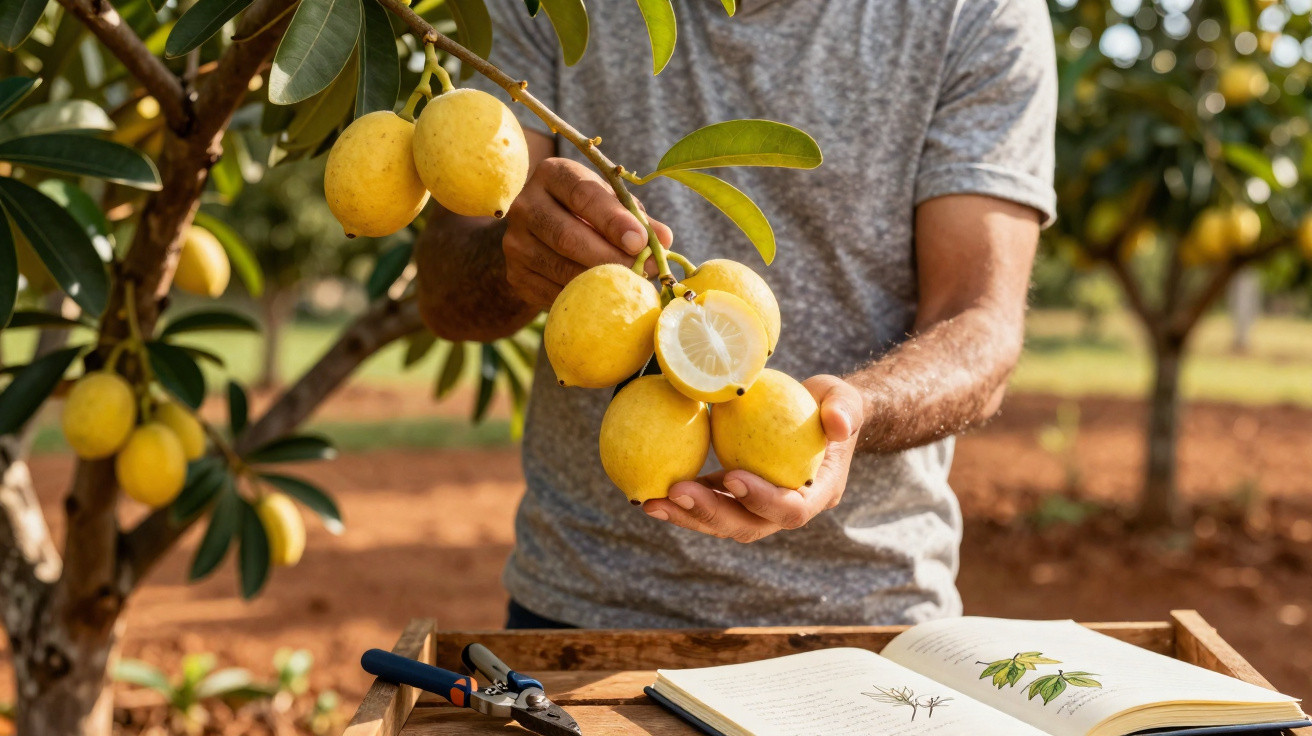
The ball marmalade, scientifically named Alibertia edulis, stands out because of its round fruit, which can look like small balls hanging from its branches. Also called puruí, black guava, calf marmalade and Cerrado quince, this tree grows in parts of the Amazon and Cerrado regions, producing fruit around 4 to 7 centimetres in diameter.
How can ball marmalade be identified by its fruit?
Ball marmalade fruit is rounded and generally measures about 4 to 7 centimetres across. Its colour changes as it develops, eventually becoming dark brown once fully ripe.
This distinctive shape explains the common name ball marmalade. Among the leaves, the almost spherical fruits are particularly noticeable and may lead the tree to be mistaken for other species that also bear rounded fruit.
Which tree produces ball marmalade?
The fruit is produced by Alibertia edulis, a member of the Rubiaceae family. It is a small evergreen tree that can grow to roughly 3 to 5 metres tall. Its flowers are white, while fruiting takes place during spring and summer.
Another notable characteristic is that male and female plants are separate: the species is dioecious, meaning that individual trees are either male or female. Female flowers are larger and fragrant, whereas male flowers are smaller and occur in more clustered groups.
Where can ball marmalade be found?
This species is found in Central and South America, including Brazil, particularly in Amazon and Cerrado areas. Adapted to tropical and subtropical environments, it can be grown in full sun.
Because of its features, ball marmalade also appeals to people seeking less familiar fruit-bearing species. Ripe fruits can be eaten and used in preparations such as jams, fruit drinks, ice cream and other products.
Why does this fruit attract so much attention?
As well as its unusual form, ball marmalade is notable for being relatively unknown to the wider public. Its rounded fruit, colour changes during ripening and the tree’s fairly compact size make it appealing both for identification and cultivation.
Therefore, if a tree has rounded fruits that darken as they ripen, green leaves and white flowers, ball marmalade may be one of the species worth considering. However, a definitive identification should be based on the plant’s full set of characteristics rather than the fruit shape alone.












Comments
No comments yet. Be the first to comment!
Leave a Comment